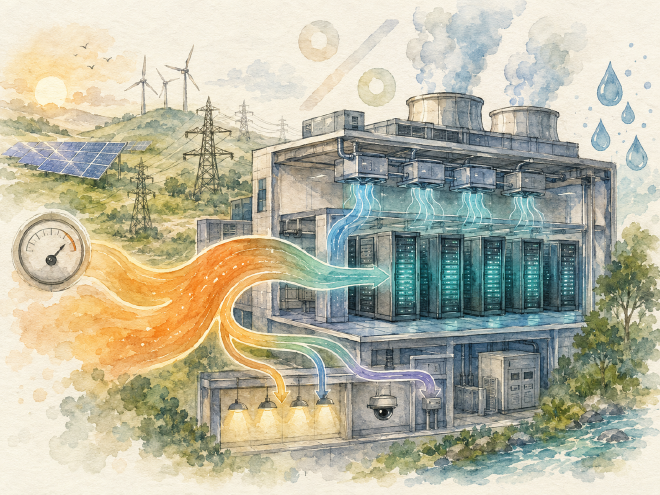
Every watt of electricity flowing into a data center has only two destinations: it either powers IT equipment doing useful work, or it disappears into cooling, lighting, power conversion, and the long list of “everything else.” The ratio between those two destinations is the single most important number in the industry. It has a name (PUE), a target (1.0), and a price tag that runs into the tens of millions of dollars per year for any operator above 10 MW.
每一瓦進到數據中心的電,只有兩個去處:要嘛驅動 IT 設備做有用的事,要嘛消失在冷卻、照明、電力轉換、以及一長串「其他所有東西」裡。這兩個去處之間的比例,是這個產業裡最重要的單一數字。它有名字(PUE)、有目標(1.0)、而對任何 10 MW 以上的營運者來說,它的價格標籤一年是數千萬美元。
Why Efficiency Has Its Own Master Metric // 為什麼能效需要一個總指標 #
A 10 MW data center running at PUE 1.5 consumes 131 GWh of electricity per year. The same data center at PUE 1.2 consumes 105 GWh. The difference — 26 GWh per year — is roughly the annual consumption of 6,000 average homes. At U.S. industrial electricity rates, it is also about $2.6 million per year in pure operating savings.
一座 10 MW 數據中心若 PUE 1.5,每年消耗 131 GWh 電。同一座機房若 PUE 1.2,年耗電 105 GWh。差距 26 GWh —— 大約是 6,000 戶美國平均家庭一年用電。換算成美國工業電價,這是純粹運營省下來的每年 $2.6M。
That kind of number explains why an entire vocabulary has grown around efficiency measurement, why governments have started writing PUE limits into regulation, and why hyperscalers are willing to relocate entire campuses to sites where the climate gives them a structural PUE advantage.
這種數字解釋了為什麼整個產業圍繞「效率量測」長出一套詞彙、為什麼政府開始把 PUE 上限寫進法規、為什麼超大規模業者願意把整座園區搬到「氣候給他們結構性 PUE 優勢」的地點。
This article walks through the PUE family of metrics — including PLF, CLF, OLF, WUE, and GUE — then turns to the space economics of white versus gray space, before showing how reliability, efficiency, and density together form an unavoidable trilemma.
這篇文章先走過 PUE 家族(含 PLF、CLF、OLF、WUE、GUE),然後轉到白空間與灰空間的空間經濟學,最後展示為什麼可靠性、能效、密度三者構成一個無法迴避的兩難。
Part 1 — What PUE Actually Measures // 第一部分:PUE 究竟在量什麼 #
PUE stands for Power Usage Effectiveness. It is the ratio of total energy entering a data center to the energy actually consumed by IT equipment.
PUE 是 Power Usage Effectiveness(電力使用效率) 的縮寫。它是「進入數據中心的總能源」除以「IT 設備實際消耗的能源」。
A PUE of 1.0 means every watt entering the building reaches an IT device — physically impossible because cooling, lighting, and power conversion always consume some energy. A PUE of 2.0 means half of all incoming electricity is wasted on non-IT functions.
PUE = 1.0 代表進入建物的每一瓦都到了 IT 設備 —— 物理上不可能,因為冷卻、照明、電力轉換永遠會消耗一部分能源。PUE = 2.0 代表進來的電有一半浪費在非 IT 功能上。
A PUE difference of 0.4 — say 1.5 down to 1.1 — saves roughly $3.5 million per year on a 10 MW data center. Over a 10-year horizon, that is enough to fund a mid-sized new build.
Five things PUE does not measure // PUE 沒有量到的五件事 #
PUE is enormously useful but also enormously gameable. Five common ways operators “improve” PUE without actually saving energy:
PUE 非常有用,但也非常容易被操弄。業者「改善」PUE 卻沒有真省電的五種常見手法:
Reporting design PUE as actual PUE. A design simulation might show 1.2; actual operations run 1.4.
把設計值當實測值報。 設計模擬可能算出 1.2;實際運轉 1.4。
Reporting winter night PUE as annual average. Beijing in January can hit PUE 1.1; Beijing in August might hit 1.5. The annual average is the honest number.
把冬夜最佳值當年平均報。 北京一月可以到 PUE 1.1;八月可能 1.5。年平均才是誠實的數字。
Reporting peak-load PUE as steady-state. PUE looks better at high utilization because the fixed overhead is amortized over more useful power.
把峰值負載 PUE 當常態 PUE。 PUE 在高利用率時看起來比較好,因為固定 overhead 被分攤到更多有用功率。
Choosing the measurement point that gives the best number. PUE measured at the UPS output is lower than PUE measured at the utility entry, because UPS losses are excluded.
Excluding parts of the load. “Forgetting” to count office space, backup cooling, or perimeter security.
「忘記」算某些用電。 漏掉辦公室、備援冷卻、周界安防。
For these reasons, The Green Grid — the consortium that maintains the standard — defines three measurement levels, with Level 3 being the most rigorous (continuous measurement at the UPS output and at the rack PDU, simultaneously). When PUE is contractually relevant, the level matters.
正因如此,維護標準的聯盟 The Green Grid 定義了三個量測等級,Level 3 最嚴格(UPS 輸出端與機櫃 PDU 同時連續量測)。當 PUE 牽涉到合約時,等級很重要。
Part 2 — The PUE Family: PLF, CLF, OLF // 第二部分:PUE 家族 —— PLF、CLF、OLF #
PUE can be decomposed into three factors that show where the overhead is going. This is the diagnostic version of PUE.
LED lighting, motion sensors, heat-recovery fresh-air systems LED 照明、動作感應、新風熱回收
CLF dominates the equation, which means cooling dominates PUE optimization. A data center with PUE 1.5 has more PUE-reduction potential in its chillers than in its UPS systems by a factor of three.
CLF 主導整個等式,意味著冷卻主導 PUE 優化。一座 PUE 1.5 的數據中心,從冷水機這邊能擠出的 PUE 改善空間,是從 UPS 那邊的三倍。
This is why almost every major optimization story — free cooling in Nordic climates, evaporative cooling in dry regions, direct-to-chip liquid cooling for AI workloads — is fundamentally a CLF story.
\[
\text{WUE} = \frac{\text{Annual water consumption (L)}}{\text{Annual IT energy (kWh)}}
\]
WUE is measured in liters of water per kWh of IT load. Typical values fall between 1.2 and 2.0 L/kWh for facilities using evaporative cooling, and can drop close to zero for facilities using air-cooled chillers.
WUE 以「每 kWh IT 負載對應多少公升水」為單位。用蒸發冷卻的機房典型值落在 1.2 到 2.0 L/kWh,用氣冷冷水機的機房可以接近零。
A 1,000-cabinet data center can consume 63,000 tons of water per year — roughly the annual water usage of 300 households in a country like the United States or Australia.
In water-scarce regions like the United Arab Emirates, Singapore, and central and southern Taiwan, WUE is becoming as politically sensitive as PUE. Some operators now face the awkward trade-off that improving PUE (via evaporative cooling) makes WUE worse.
在缺水地區(如阿聯酋、新加坡、台灣中南部),WUE 在政治上正變得跟 PUE 一樣敏感。部分業者現在面對一個尷尬的權衡:改善 PUE(用蒸發冷卻)會讓 WUE 變差。
This tension — PUE-versus-WUE — is one of the more underappreciated structural issues in modern data center design. We will return to it in the design-trade-offs section.
這個張力 —— PUE vs. WUE —— 是現代數據中心設計裡比較少被討論的結構性議題之一。後面設計取捨章節會回頭談。
\[
\text{GUE} = \frac{\text{IT power capacity}}{\text{Total grid power capacity}} = \frac{1}{\text{Peak PUE}}
\]
GUE is the inverse of peak PUE. It measures what fraction of the grid capacity you applied for actually reaches IT equipment.
GUE 是峰值 PUE 的倒數。它衡量你申請的電網容量,最終有多少抵達 IT 設備。
Peak PUE
GUE
Implication // 意義
2.0
0.50
Half the grid capacity you paid for is overhead 申請來的電網容量一半是 overhead
1.5
0.67
One-third still overhead 三分之一仍是 overhead
1.2
0.83
Most reaches IT 大部分到 IT
1.1
0.91
Near-maximum grid utilization 接近最大電網利用率
This matters because, as discussed in article 3, grid connection has become the single longest lead-time item in data center construction. A higher GUE means the same scarce grid connection supports more IT capacity — a 10 MVA grid connection at PUE 1.1 can host 9.1 MW of IT load, while the same connection at PUE 1.5 can host only 6.7 MW.
這很重要,因為(如第 3 篇所述)電網接入已經成為數據中心建設裡交期最長的單一項目。較高的 GUE 意味著同一條稀缺的電網接入支撐更多 IT 容量 —— 10 MVA 電網接入在 PUE 1.1 可承載 9.1 MW IT 負載,同一條接入在 PUE 1.5 只能承載 6.7 MW。
In markets with multi-year grid connection backlogs (Northern Virginia, Dublin, Frankfurt, Singapore), GUE has quietly become as commercially important as PUE.
在電網接入排隊數年的市場(Northern Virginia、Dublin、Frankfurt、新加坡),GUE 已經悄悄變得跟 PUE 一樣具商業重要性。
A growing number of jurisdictions have moved PUE from “best practice” to “legal requirement”:
越來越多司法管轄區把 PUE 從「最佳實踐」升級為「法律要求」:
Region
New-build PUE limit
Existing facility limit
China (national)
< 1.4
< 1.8
Beijing
< 1.3
< 1.5
Shanghai
< 1.3
—
Singapore
< 1.3 (new builds)
—
EU (CSRD direction) 歐盟(CSRD 方向)
< 1.3 by 2030
—
United States
No federal mandate; industry self-regulated 無聯邦強制;業界自律
—
The regulatory direction is unambiguous: PUE caps will keep tightening, and the legal floor of “acceptable” PUE will fall toward 1.2 over the next decade.
法規方向很清楚:PUE 上限會持續收緊,「可接受 PUE」的法律底線未來十年會降到 1.2 附近。
Part 5 — The Four PUE Optimization Levers // 第五部分:PUE 優化的四大槓桿 #
PUE improvement opportunities exist at four points in a data center’s life. The earlier the decision, the larger the lever.
Less reliance on backup generators, lower PLF 少依賴備援,降低 PLF
Renewable power available
No direct PUE impact, but transforms ESG profile 不直接影響 PUE,但改變 ESG 樣貌
This is why Google operates a major facility in Hamina, Finland; why Apple’s Maiden, North Carolina campus runs on solar; and why Microsoft taps hydropower from the Columbia River in Quincy, Washington.
這就是為什麼 Google 在芬蘭哈米納運轉、Apple 北卡 Maiden 園區用太陽能、Microsoft 在華盛頓州 Quincy 用 Columbia 河水力電。
Decided in the design phase, very expensive to change later.
設計階段決定,事後變更非常貴。
Design choice
PUE impact
UPS efficiency 93% → 96%
PUE −0.03
HVDC / Panama architecture HVDC / Panama 架構
PUE −0.02 to −0.05
Free cooling design 自然冷卻設計
PUE −0.1 to −0.2
Hot/cold aisle containment 冷熱通道封閉
PUE −0.05 to −0.1
In-row cooling (vs room-level) 行間冷卻(vs 房間級)
PUE −0.05
Liquid cooling (vs air) 液冷(vs 氣冷)
PUE −0.1 to −0.2
High inlet temperature (27°C vs 22°C) 高進氣溫度(27°C vs 22°C)
PUE −0.05 to −0.1
The high-inlet-temperature lever is notable because it costs essentially nothing — it is a setpoint change. The ASHRAE TC 9.9 guidelines now explicitly support recommended IT inlet temperatures up to 27°C, and many hyperscalers run their facilities even warmer.
「高進氣溫度」這個槓桿值得注意,因為它幾乎不花錢 —— 只是設定點變更。ASHRAE TC 9.9 規範現在明確支持 IT 進氣溫度可達 27°C,很多超大規模業者跑得更熱。
Huawei iCooling — Used in the Qinghai (Hainan, China) renewable-powered campus, controlling 96 in-row cooling units in a coordinated optimization loop. Reported cooling energy reduction: about 8%, translating to roughly 0.05–0.1 PUE improvement.
Google DeepMind — In a widely cited 2016 case study, applied reinforcement learning to control cooling parameters at one of Google’s data centers. Reported cooling energy reduction: 40%, with overall PUE improvement of roughly 15%.
Google DeepMind —— 2016 年廣為引用的案例,用強化學習控制 Google 一座數據中心的冷卻參數。報告冷卻能耗降低 40%,整體 PUE 改善約 15%。
AI-driven PUE optimization is now treated as a near-mandatory component for any new hyperscale build. The technology has crossed from research curiosity to standard procurement requirement in roughly five years.
AI 驅動的 PUE 優化現在已經被當成新建超大規模 DC 幾乎必備的元件。這個技術在約五年內從研究稀奇變成標準採購要求。
Lever              PUE Impact     Decision point     Reversibility
────────────────────────────────────────────────────────────────────
Site selection     Largest        Planning           Locked once built
Design             Large          Design             Expensive to change
Operations         Medium         Operations         Continuously available
AI optimization    Medium-large   Operations         Continuously available
The cheapest dollar spent on PUE is the one spent during site selection. The most expensive dollar is the one spent ten years later, trying to retrofit a poorly sited facility.
花在 PUE 上最便宜的一塊錢是花在選址期間。最貴的一塊錢是十年後,試圖改造一座選址不佳的機房。
Part 6 — White Space and Gray Space // 第六部分:白空間與灰空間 #
PUE measures how efficiently a data center converts grid power into useful IT work. Space economics measures how efficiently the same data center converts square meters into rentable or productive cabinet positions.
PUE 量「電網電力轉成有用 IT 工作」的效率。空間經濟學量同一座數據中心「平方公尺轉成可出租或可生產機櫃位置」的效率。
A handful of structural reasons explain the 65% gray-space proportion:
灰空間佔 65% 的結構性原因有幾個:
Cooling plant footprint — Chillers, cooling towers, and heat exchangers occupy significant area; large facilities can dedicate over 30% of total floor area to cooling.
冷卻廠佔地 —— 冷水機、冷卻塔、熱交換器佔不小面積;大型機房可以把總樓面 30%+ 給冷卻用。
Electrical infrastructure — Transformers, UPS rooms, switchgear, and battery rooms each require dedicated, often fire-rated, space with separation requirements.
The gap between a traditional 12 m²/cabinet design and a modern 3 m²/cabinet design is roughly 4×. For an operator building 5,000 cabinets, that is the difference between a 60,000 m² building and a 15,000 m² building — measured in tens of millions of dollars of construction cost.
傳統 12 m²/櫃 跟現代 3 m²/櫃 設計之間的差距大約是 4 倍。對一個要蓋 5,000 機櫃的營運者來說,這就是 60,000 m² 大樓與 15,000 m² 大樓的差別 —— 用「數千萬美元的建設成本」來衡量。
A 1,000-cabinet data center where each cabinet draws 4 kW supports 4 MW of IT load. The same 1,000-cabinet building where each cabinet draws 20 kW supports 20 MW of IT load. The building is the same; the revenue potential is 5× higher.
一座 1,000 機櫃的數據中心,若每櫃 4 kW,承載 4 MW IT 負載。同一座 1,000 機櫃建物,若每櫃 20 kW,承載 20 MW IT 負載。建物一樣,營收潛能高 5 倍。
This is the central economic argument for high-density designs — and for the liquid cooling required to make them possible.
這是高密度設計(與其所需的液冷)核心的經濟論點。
Cabinet density historical trajectory // 機櫃密度歷史軌跡 #
1990s    ~1 kW/cabinet      (legacy mainframes)
2000s    2–4 kW/cabinet     (early x86 server era)
2010s    4–8 kW/cabinet     (virtualization mainstream)
Early 2020s    8–15 kW/cabinet    (cloud workloads)
Mid 2020s    20–50 kW/cabinet   (AI/GPU clusters)
Late 2020s    100+ kW/cabinet    (NVIDIA NVL72, future)
Cooling technology has to follow this curve. Air cooling fails above roughly 20–25 kW/cabinet. Anything denser requires liquid cooling — increasingly direct-to-chip or immersion.
This is the central design insight of modern data center engineering. Three core KPIs constrain each other, and improving any one tends to come at the cost of the others.
Higher reliability fights against higher density. A Tier IV facility with 2N redundancy needs twice the equipment, twice the gray space, and physical separation between the two systems. A 5,000-cabinet Tier IV facility takes roughly 30% more building area than a 5,000-cabinet Tier III facility.
更高可靠性與更高密度衝突。 2N 冗餘的 Tier IV 機房需要兩倍設備、兩倍灰空間、兩套系統物理分隔。一座 5,000 機櫃的 Tier IV 機房比同樣 5,000 機櫃的 Tier III 機房多用約 30% 建物面積。
Lower PUE often fights against higher density. Free cooling requires large air-handler units, deep evaporative pads, or long heat-exchanger loops. Liquid cooling distribution units (CDUs) take their own space inside the building. The PUE-optimal facility is often less SUE-optimal.
較低 PUE 常常與更高密度衝突。 自然冷卻需要大型空氣處理機、深層蒸發墊或長熱交換迴路。液冷分配單元(CDU)在建物內也有自己的佔地。PUE 最優的機房常常 SUE 不是最優的。
Higher density often fights against lower PUE. A 50 kW/cabinet rack produces concentrated heat that requires aggressive cooling, frequently liquid. The initial CAPEX for that cooling pushes PUE upward in the short term, even though it usually settles lower in steady state.
更高密度常常與較低 PUE 衝突。 50 kW/櫃的機櫃製造密集熱量,需要積極冷卻、通常是液冷。這部分冷卻的初期 CAPEX 短期會把 PUE 推高,雖然穩定態通常會降下去。
How the industry bends the triangle // 業界怎麼彎這個三角 #
Modern designs attack the trilemma through a coordinated package of technologies:
現代設計透過一組協同技術攻擊這個兩難:
Modular + prefabricated layouts compress gray space and shorten time-to-market simultaneously
模組化 + 預製化 同時壓縮灰空間並縮短上市時間
In-row cooling brings cold air closer to heat sources, reducing both fan energy (CLF) and the air-handling footprint
行間冷卻 把冷空氣帶近熱源,同時降低風扇能耗(CLF)與空氣處理佔地
Liquid cooling at the cabinet breaks the air-cooling density ceiling and pushes PUE down at the same time
機櫃級液冷 打破氣冷密度天花板,同時把 PUE 往下推
Smart busbar power distribution replaces traditional cable trays, freeing gray space and enabling rack-level reconfiguration
智能母線配電 取代傳統線槽,釋放灰空間並允許機櫃級重組
AI-driven cooling control continuously rebalances setpoints across the facility
AI 驅動冷卻控制 持續在整棟機房內重新平衡設定點
These technologies do not eliminate the triangle. They bend its sides outward. A modern PMDC with liquid-cooled cabinets and AI-controlled cooling can hit Tier III, PUE 1.2, and 4 m²/cabinet simultaneously — territory that was geometrically impossible a decade ago.
這些技術沒有消滅三角形。它們把三角形的邊往外彎。一座現代 PMDC(搭配液冷機櫃與 AI 控冷)可以同時達到 Tier III、PUE 1.2、4 m²/櫃 —— 十年前在幾何上不可能的領地。
Part 9 — AI Is Rewriting Space Economics // 第九部分:AI 正在改寫空間經濟學 #
The AI buildout has compressed a decade of density evolution into 24 months.
AI 擴建把十年的密度演進壓縮進 24 個月。
Era
Typical density
Traditional enterprise (pre-2020)
4–8 kW/cabinet
Hyperscale cloud (2020–2023)
8–15 kW/cabinet
AI training cluster (NVIDIA H100, 2023–2024)
30–50 kW/cabinet
GPU rack-scale (NVIDIA NVL72, 2025+)
120 kW/cabinet
Projected (Vera Rubin Ultra, 2027+)
600 kW/cabinet
The implications for facility design are severe. A 5,000-cabinet building at 8 kW/cabinet hosts 40 MW of IT load. The same 5,000-cabinet building at 50 kW/cabinet hosts 250 MW of IT load — assuming the cooling, electrical distribution, and structural floor loading can be redesigned to support it. Most cannot, which is why pure AI training campuses are now being built from scratch rather than retrofitted into existing facilities.
對設施設計的影響很激烈。一座 5,000 機櫃 8 kW/櫃的機房承載 40 MW IT 負載。同樣 5,000 機櫃 50 kW/櫃的機房承載 250 MW IT 負載 —— 假設冷卻、電氣配電、結構樓板承重都能重新設計支撐。大多數做不到,這就是為什麼純 AI 訓練園區現在是從零開始蓋,而不是改造既有機房。
The AI workload is not just a denser version of the cloud workload. It is a structurally different building.
AI 工作負載不只是雲端工作負載的更密版本。它是一棟結構性不同的建物。
This is the fault line currently splitting the data center industry into two design philosophies:
這就是當前數據中心產業分裂成兩種設計哲學的斷層:
Traditional / cloud workload facilities — Tier III, PUE 1.3–1.5, 8–15 kW/cabinet, air-cooled, large building footprint
1. PUE is the industry’s master efficiency metric // PUE 是這個產業的能效總指標 #
Total facility power divided by IT power. World-class is 1.1; global average is 1.5; regulatory floors in major markets are heading toward 1.3 over the next decade.
總設施電力除以 IT 電力。世界級 1.1;全球平均 1.5;主要市場的法規底線未來十年朝 1.3 走。
Of the three PUE factors (PLF, CLF, OLF), the cooling load factor (CLF) is by far the largest and most addressable. Almost every major optimization story is fundamentally a CLF story.
PUE 三因子中,冷卻負載因子(CLF)目前為止最大、最可優化。幾乎每個主要的優化故事本質上都是 CLF 的故事。
3. WUE and GUE are the second-tier metrics that matter // WUE 與 GUE 是值得關注的次級指標 #
WUE matters in water-scarce regions and creates an awkward trade-off with PUE. GUE matters anywhere grid connection is constrained — which now includes most major markets globally.
WUE 在缺水地區重要,並與 PUE 形成尷尬權衡。GUE 在電網受限的地方重要 —— 現在包括全球大部分主要市場。
4. Site selection is the single biggest PUE lever // 選址是 PUE 最大的單一槓桿 #
A site at 8°C annual mean temperature can structurally hit PUE 1.15. The same operator’s design at 25°C annual mean temperature might struggle to hit 1.4. The siting decision is locked once construction starts.
年均溫 8°C 的選址結構上能打 PUE 1.15。同樣業者在年均溫 25°C 的設計可能連 1.4 都吃力。動工後選址鎖死。
5. AI-driven cooling control is now standard // AI 驅動冷卻控制現在是標準 #
Huawei iCooling, Google DeepMind cooling control, and similar systems have moved from research curiosities to standard procurement requirements in roughly five years.
6. Only one square meter in three is rentable // 每三平方公尺只有一平方公尺可出租 #
White space (housing IT) is typically only 35% of total building area. Gray space (housing supporting infrastructure) is the other 65%. Modern modular and high-density designs are pushing this ratio closer to 50/50.
7. The Impossible Triangle constrains every design // 不可能三角約束每個設計 #
Reliability (Tier) × Efficiency (PUE) × Density (SUE) cannot all be maximized at once. Modern designs bend the triangle through modular layouts, liquid cooling, and AI control — but cannot eliminate it.
8. AI workloads are a structurally different building // AI 工作負載是結構性不同的建物 #
NVIDIA NVL72 at 120 kW/cabinet, with Vera Rubin Ultra projected at 600 kW/cabinet, has compressed a decade of density evolution into 24 months. The result is a fork in the industry between traditional cloud facilities and AI/HPC facilities that now look like separate engineering disciplines.
The sixth article in this series goes deep into the power system — the UPS, HVDC and Panama architectures, diesel gensets, switchgear, automatic transfer switches, static transfer switches, and the smart busbar concept that is replacing traditional cable trays. We’ll trace the full path from the utility connection through to the rack PDU, with particular attention to where lead times now run six months to several years.
本系列第 6 篇深入電力系統 —— UPS、HVDC 與 Panama 架構、柴油發電機、開關設備、自動切換開關、靜態切換開關、以及取代傳統線槽的智能母線概念。我們會把從電力公司接入到機櫃 PDU 的完整路徑走一遍,特別注意現在交期從六個月到數年的地方。