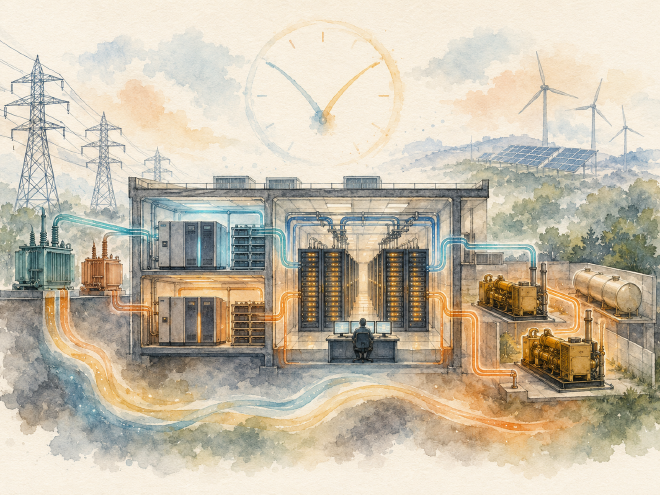
When the lights flicker in a normal building, the occupants notice but life continues. When the lights flicker in a data center, a modern server has roughly 16 milliseconds before its internal capacitors drain and the operating system crashes. Sixteen thousandths of a second. That single brutal physical constraint is why a data center’s electrical system is more complex than the power infrastructure of a small town — and why an entire engineering discipline has been built around guaranteeing those 16 milliseconds are never crossed, even during a transformer fire, a substation explosion, or a major regional blackout.
Why the Power Chain Has Five Layers // 為什麼電力鏈有五層 #
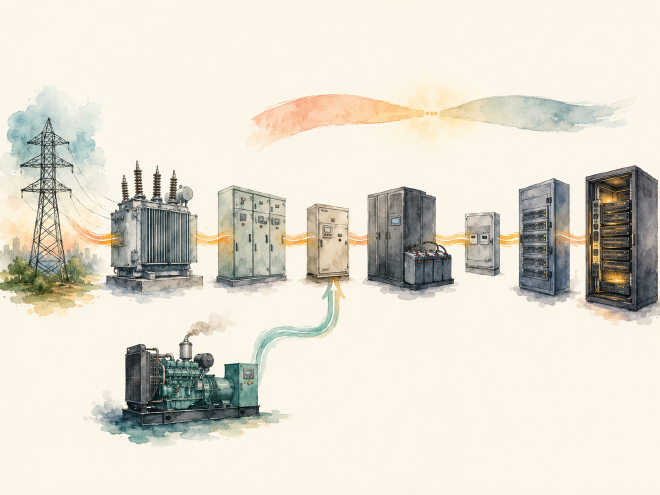
A data center’s power system is built as a sequence of defenses, each catching what the previous one missed. From the moment electricity leaves the utility’s transmission line to the moment it enters a server’s power supply, it passes through at least five distinct subsystems — each with its own failure modes, redundancy patterns, and time-to-respond budget.
This article walks the full chain — utility connection, switchgear, automatic transfer switch, UPS, static transfer switch, distribution, and rack PDU — and then turns to the modern alternatives like HVDC, Panama architecture, and smart busbar that are rewriting the textbook.
The chain has many components, but five of them carry disproportionate responsibility:
鏈條有很多元件,但五個承擔不成比例的責任:
Node // 節點
Function // 功能
Failure consequence // 故障後果
Transformer
Voltage step-down 降壓
Whole facility down 整廠停電
ATS
Switches between utility and genset 市電與發電機之間切換
Backup can’t take over 備援無法接管
UPS
Bridges the 30-second gap between utility failure and genset startup 橋接市電中斷與發電機啟動的 30 秒空檔
IT loses power immediately IT 立即斷電
Genset
Long-duration backup 長時間備援
UPS batteries deplete, then IT down UPS 電池耗盡,IT 斷電
PDU / rPDU
Final distribution to the cabinet 最後分配到機櫃
Cabinet-level outage 該機櫃停電
The time budgets are unforgiving. The ATS has to detect a failure and switch in well under one second. The UPS has to take over within milliseconds. The genset must start, stabilize, and synchronize within roughly 30 seconds. If any one of these misses its window, the chain breaks.
Part 2 — Three Power Architectures: UPS, HVDC, Panama // 第二部分:三種電力架構 #
At the highest level of design, the industry has three approaches to bridging the utility-to-server gap. One dominates; two are alternatives that have been tried and remain mostly experimental.
Maintenance bypass available — facility can be serviced without taking IT offline
可用維修旁路 —— 機房可以保養而不下線 IT
Wide engineering talent pool — anyone trained on electrical systems understands UPS
廣泛的工程人才池 —— 任何電氣系統訓練過的人都懂 UPS
HVDC eliminates one AC/DC conversion stage and is theoretically more efficient, but requires customized server power supplies, breaks the standard supply chain, and offers no compelling overall efficiency advantage in practice. Panama goes further by integrating the medium-voltage transformer with HVDC conversion — interesting on paper, but only deployed in limited Alibaba projects.
Modern data center UPS systems use the online double-conversion topology. The name describes the two conversions:
現代數據中心 UPS 用在線雙轉換拓樸。名字描述了兩次轉換:
AC from the utility enters a rectifier that converts it to DC. // 從電力公司來的 AC 進入整流器轉成 DC。
The DC bus feeds an inverter that converts it back to AC for the IT load. // DC 母線餵給逆變器,把它轉回 AC 給 IT 負載。
In parallel, the same DC bus charges the battery string. // 平行地,同一條 DC 母線充電給電池組。
When the utility fails, the rectifier stops, the battery instantly takes over feeding the DC bus, and the inverter continues outputting clean AC. From the server’s perspective, nothing happened — the inverter has been the only power source the IT load has ever seen.
當市電失效,整流器停止,電池立即接手餵 DC 母線,逆變器繼續輸出乾淨的 AC。從伺服器的角度看,什麼事都沒發生 —— 逆變器一直是 IT 負載唯一見過的電源。
The cost of this elegance is conversion loss. Each conversion stage is roughly 96–98% efficient, so two stages compound to about 93–96% end-to-end. This is why the UPS efficiency war between vendors — Vertiv 95%, Huawei 96%, Schneider 96% — translates directly into PUE.
Single integrated unit, fixed capacity 單一整合單元、固定容量
Small facilities, no expansion need 小型機房、無擴展需求
Modular UPS
Multiple hot-swappable power modules sharing a common chassis 多個熱插拔電源模組共用機箱
All modern IDCs, CDCs, mid-to-large EDCs 所有現代 IDC、CDC、中大型 EDC
Integrated UPS
UPS + power distribution combined in one cabinet, sized for a prefabricated module UPS + 配電合在一個機櫃,配合預製化模組
PMDCs, edge data centers PMDC、邊緣 DC
Modular UPS has become the industry default since the early 2010s, for three reasons: hot-swap maintenance without de-energizing the facility, easier N+1 redundancy by adding one extra module, and capacity scaling by adding modules instead of replacing the chassis.
Every UPS has at least one bypass path: a direct connection from the utility input to the output, used during maintenance or fault. There are two kinds:
每台 UPS 至少有一條旁路路徑:從市電輸入直接連到輸出,在保養或故障時用。有兩種:
Maintenance bypass — manual switch that lets the UPS be powered down for service while the load continues running off raw utility power
維護旁路 —— 手動開關,讓 UPS 停機保養,同時負載繼續用原始市電
Static bypass — automatic switch (semiconductor-based) that engages during overload or internal UPS fault
靜態旁路 —— 自動開關(半導體),在過載或 UPS 內部故障時啟動
Both are critical to operational continuity. A UPS without maintenance bypass cannot be serviced without taking IT offline, which is why HVDC (which lacks maintenance bypass) is unsuitable for most applications.
Part 4 — Batteries: From VRLA to Lithium // 第四部分:電池 —— 從 VRLA 到鋰電 #
The battery is the part of the UPS that actually holds the energy during a utility outage. The battery layer has changed more in the last five years than in the previous thirty.
Valve-Regulated Lead-Acid (VRLA) batteries have dominated data center backup for forty years. Mature supply chain, low CAPEX, well-understood failure modes. But a 5-to-7 year lifespan, large footprint, and stringent temperature requirements (degradation accelerates above 25°C) increasingly look unattractive.
Lithium-ion (Li-ion): the new mainstream // 鋰電:新主流 #
Lithium-ion adoption in data centers accelerated after 2018. The economics now favor lithium even at higher CAPEX, because the longer lifespan and smaller footprint repay the difference within the equipment lifecycle.
Lithium thermal runaway — where a damaged or overheated cell triggers an exothermic chain reaction — is the one failure mode lead-acid does not have. Fire protection design for lithium battery rooms is meaningfully different, sometimes involving fluorocarbon gas plus water mist as a dual-stage approach.
The actual lithium cells inside a Huawei SmartLi or Vertiv lithium UPS come from the same handful of cell makers that supply the EV industry: CATL, BYD, EVE Energy, Samsung SDI, LG Energy Solution, Panasonic. As article 3 noted, this means data center battery procurement now competes directly with electric vehicles for the same cells.
Part 5 — Gensets: The Last Line of Defense // 第五部分:發電機 —— 最後一道防線 #
The UPS bridges seconds. The genset bridges hours.
UPS 橋接秒。發電機橋接小時。
A typical data center is designed so that the UPS battery can carry the IT load for 5 to 15 minutes, which is comfortably longer than the 20 to 30 seconds a diesel genset needs to start, stabilize, and synchronize to the load. Once the genset takes over, it can carry the facility for as long as the fuel supply lasts — typically 24 to 72 hours stored on-site, with refueling contracts for longer outages.
Increasingly, data centers deploy gensets pre-installed in standard 40-foot containers, with fuel system, exhaust silencer, and switchgear integrated at the factory. The container arrives on site, gets connected to fuel and electrical infrastructure, and is operational within days rather than months. This is part of the broader prefabrication trend covered in a later article.
Part 6 — Switchgear: HV, MV, LV, and Form Levels // 第六部分:開關設備 —— HV、MV、LV 與 Form 等級 #
Between every voltage step-down in a data center sits a switchgear cabinet — physically large, fire-rated enclosures containing circuit breakers, busbars, metering, and protection relays.
MDB (Main Distribution Board)
       ↓
SMDB (Sub-Main Distribution Board)
       ↓
DB (Distribution Board)
       ↓
End loads (PDUs, cooling units, lighting, etc.)
The MDB is the main feeder, typically 2,500–4,000 A. The SMDB is the intermediate stage, installed near load centers. The DB serves end loads — PDUs, mechanical equipment, lighting.
Form levels — the safety hierarchy // Form 等級 —— 安全層級 #
IEC 61439 (and the Chinese GB 7251 equivalent) defines seven “Form” levels for low-voltage switchgear, classifying how completely the internal components — busbars, switches, terminals — are physically isolated from each other.
Terminals and switches in shared compartment 端子與開關同隔艙
High safety
Form 4b
Terminals, busbars, and switches all fully isolated 端子、母線、開關全部隔離
Highest safety 最高安全
The industry mainstream is Form 3b. Tier IV financial facilities frequently specify Form 4b. The trade-off is that higher Form levels are more expensive and have worse natural heat dissipation, so they need active cooling inside the cabinet.
業界主流是 Form 3b。Tier IV 金融機房常指定 Form 4b。權衡是更高 Form 等級更貴、自然散熱差,所以櫃內需要主動冷卻。
ACB and MCCB units are usually specified with a “trip unit” that defines what events trigger the breaker. The standard nomenclature is LSIG:
ACB 與 MCCB 通常配「跳脫單元」,定義什麼事件觸發斷路器。標準命名是 LSIG:
L — Long-time (overload protection) // 長延時(過載保護)
S — Short-time (short-delay) // 短延時
I — Instantaneous (short-circuit) // 瞬時(短路)
G — Ground fault // 接地故障
A breaker specified as “LSIG” has full four-function protection. Cheaper variants drop one or more letters. For Tier III/IV facilities, LSIG is the standard.
Schneider Electric — Masterpact (ACB), Compact NSX (MCCB), Acti9 (MCB)
ABB — Emax (ACB), Tmax (MCCB), S200 (MCB)
Siemens — 3WL (ACB), 3VL (MCCB), 5SL (MCB)
Mitsubishi Electric — AE (ACB), NF (MCCB)
Eaton — Magnum (ACB), Series G (MCCB)
A common procurement pattern is to standardize on a single vendor’s full family of breakers across a facility — it simplifies protection coordination, spare parts, and engineer familiarity.
常見採購做法是整廠標準化在單一廠商的全系列斷路器 —— 簡化保護協調、備品、工程師熟悉度。
Part 8 — ATS vs STS: The Two Switching Technologies // 第八部分:ATS vs STS —— 兩種切換技術 #
Two different switches sit at two different places in the chain, with two very different time budgets.
This is slow by IT standards, but the UPS is already carrying the load. The ATS does not need to be fast enough to keep IT online — it just needs to be reliable enough to bring the genset into service before the UPS battery depletes.
以 IT 標準算慢,但 UPS 已經扛著負載。ATS 不需要快到讓 IT 不下線 —— 只需要可靠到在 UPS 電池耗盡之前把發電機帶上線。
Function: Switches between two UPS paths (A side and B side) downstream of the UPS.
功能: 在 UPS 下游兩條路徑(A 邊與 B 邊)之間切換。
Switching time:Less than 4 milliseconds.
切換時間:少於 4 毫秒。
This is fast because it has to be. The STS feeds IT equipment directly. A switch slower than the server power supply’s hold-up time would cause servers to reset.
這個快是必須的。STS 直接餵 IT 設備。比伺服器電源 hold-up 時間慢的切換會讓伺服器重啟。
The technology is fundamentally different — STS uses semiconductor switching (SCR or IGBT), not mechanical contacts. This is why it is sub-4-millisecond fast and also why it is meaningfully more expensive than an ATS of equivalent current rating.
The ATS and STS are often confused in writing because both have “transfer switch” in the name. The practical difference — 1,000× in switching speed — is exactly the gap between “keeping the facility running” and “keeping the servers from rebooting.”
Part 9 — PDU and rPDU: The Last Mile // 第九部分:PDU 與 rPDU —— 最後一哩 #
After all the high-amperage upstream infrastructure, the power finally arrives at the racks via two simpler-looking devices.
在所有高電流上游基礎設施之後,電力最終透過兩個看起來較簡單的裝置抵達機櫃。
Device
What it is
Where it sits
PDU (Power Distribution Unit)
Floor-standing cabinet, 100–400 A, distributes to multiple racks 地面式機櫃、100–400 A、配電到多個機櫃
Outside or at the end of a row
rPDU (Rack PDU)
Rack-mounted power strip with multiple outlets per rack 機櫃內的多孔電源條
Inside the cabinet
A traditional rPDU is just a power strip with monitoring. A modern intelligent rPDU measures voltage, current, power, energy, and temperature at every individual outlet — typically 24 to 48 outlets per rPDU.
This per-outlet visibility matters because it lets data center management software trace power consumption to individual servers, detect early-warning anomalies like rising contact temperature, and execute remote on/off control during incident response.
Part 10 — Smart Busbar: The Cable Alternative // 第十部分:智能母線 —— 電纜的替代方案 #
For decades, the standard way to feed PDUs from upstream switchgear was overhead or underfloor copper cable. Smart busbar is the increasingly dominant alternative — a continuous overhead rail with snap-in PDU tap-off boxes.
Traditional cabling versus smart busbar // 傳統電纜 vs 智能母線 #
Traditional:
PDC → cable → rack 1
       ↓
       cable → rack 2
              ↓
              cable → rack 3 ...

Each rack requires running new cable. Reconfiguring means powering down.

Smart busbar:
PDC → [Input unit] → ===CONTINUOUS BUSBAR===
                          ↓        ↓        ↓
                       [PDU]    [PDU]    [PDU]
                          ↓        ↓        ↓
                       rack 1   rack 2   rack 3

Adding or moving a rack means clipping a new PDU tap onto the bar.
The three components of a smart busbar system:
智能母線系統的三個元件:
GIU (General Input Unit,進線單元) — Feeds power from the upstream switchgear into the busbar // 從上游開關設備把電送進母線
BTU (Busbar Trunking Unit,母線槽) — The continuous overhead bar // 連續的頂部母線
PDU tap-off boxes 取電盒 — Snap onto the bar to feed individual cabinets // 卡到母線上餵單一機櫃
The advantages over traditional cabling are significant: hot-swappable cabinet additions without de-energizing, far shorter installation time, real-time per-circuit monitoring, fewer cable joints (each of which is a potential failure point), and lower fire risk in the overhead routing zone.
Starline (Universal Electric) — Data center–specialized Track Busway leader
Schneider Canalis / I-LINE
ABB, Siemens, Eaton, Legrand — Industrial-scale
Huawei Smart Busbar — Integrated with FusionModule offerings
Part 11 — Lead Times Across the Power Chain // 第十一部分:電力鏈各環節的交期 #
As article 3 detailed, power equipment lead times have stretched dramatically since 2020. The headline numbers, focused on the power chain:
如第 3 篇所述,電力設備交期自 2020 年起大幅拉長。聚焦電力鏈的主要數字:
Item
Pre-2020 lead time
2025–2026 lead time
High-voltage transformer
12 months
3–5 years
Medium-voltage switchgear
3 months
12–18 months
Low-voltage switchgear (LVSG)
8 weeks
9–15 months
Diesel genset (1–2 MW)
4 months
6–12 months
Large UPS (500 kVA+)
3 months
4–9 months
Lithium-ion battery cells
3 months
6–12 months
Grid connection (100 MW)
18 months
3–7 years
The pattern is unambiguous: every category has lengthened, and the longest lead times are now at the upstream-of-the-data-center end (transformers and grid connections), where the supply chain crosses into raw materials and utility infrastructure that no individual data center operator controls.
1. The power chain has at least five critical nodes // 電力鏈至少有五個關鍵節點 #
Transformer, ATS, UPS, genset, PDU/rPDU. Each has its own failure modes, redundancy patterns, and time-to-respond budget. The chain only works when every node holds.
2. UPS won the architecture war through ecosystem, not pure technical merit // UPS 靠生態系統而非純技術贏架構戰 #
Online double-conversion UPS holds over 90% of the market. HVDC and Panama are technically reasonable but lack the supply chain, talent pool, and standard server compatibility that UPS commands.
在線雙轉換 UPS 拿超過 90% 市佔。HVDC 與 Panama 技術上合理,但缺乏 UPS 擁有的供應鏈、人才池、標準伺服器相容性。
3. Lithium-ion has replaced VRLA as the default for new builds // 鋰電已取代 VRLA 成為新建預設 #
10–15 year lifespan, 95–98% efficiency, 60% smaller footprint — but with thermal runaway risk that requires fundamentally different fire protection design.
4. ATS and STS are different switches // ATS 與 STS 是不同的開關 #
ATS switches between utility and genset, 50–200 ms, mechanical. STS switches between two UPS paths, < 4 ms, semiconductor. The naming is confusingly similar; the time gap is 1,000×.
5. The 1,800 kW genset is the cost-per-kW sweet spot // 1,800 kW 發電機是性價比甜蜜點 #
Standard parts, abundant service, easy parallel operation. Single low-voltage gensets cap out at 2,400 kW; parallel arrays cap at about 10 units. Larger needs go to medium-voltage gensets.
6. Smart busbar is replacing cable trays in modern builds // 智能母線正在取代現代新建的線槽 #
Hot-swappable cabinet additions, faster installation, real-time monitoring, fewer joints. Industry mainstream within five years for new modular data centers.
熱插拔加機櫃、更快安裝、即時監控、更少接點。五年內成為新建模組化數據中心的業界主流。
7. Lead times have lengthened across the entire chain // 整條鏈的交期都拉長 #
The longest stretching is at the upstream end (transformers, grid connection), now measured in years. Procurement strategy has shifted toward reserving capacity years ahead of design completion.
The seventh article in this series turns from electricity to heat — the cooling system. We’ll cover the four classic cooling architectures (DX, CW, AHU, EHU), the rise of free cooling and evaporative cooling, hot/cold aisle containment, and the dramatic shift to liquid cooling now being forced by AI workloads. CLF dominates PUE, which means cooling dominates the energy story — and the cooling chain is changing faster than at any time in the past forty years.