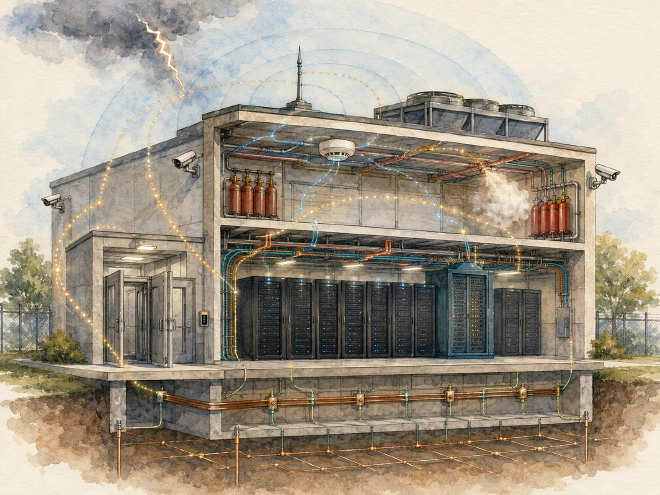
Add up fire suppression, cabinets, structured cabling, physical security, and lightning/grounding — the five subsystems this article covers — and they account for less than 15% of a data center’s CAPEX. They get almost none of the marketing attention given to UPS systems, chillers, or AI GPUs. And yet every one of them contains failure modes that can take down an entire facility in a way no UPS redundancy can rescue. A fire suppression chemical going off-market reshapes thousands of buildings. A grounding error melts a $500,000 transformer. A geopolitical decision in Washington restricts a camera brand that was specified into half the world’s data centers.
Why the “Small” Subsystems Deserve a Dedicated Article // 為什麼「小」子系統值得專文討論 #
The five subsystems in this article are small as a percentage of capital cost but disproportionate in their ability to cause catastrophic, uninsurable outcomes. Their economics, supply chains, and engineering trade-offs are also genuinely different from the headline systems — fire and security in particular have geopolitical dimensions that affect procurement choices in ways the chillers and UPS market does not.
This article also marks a transition in the series. The previous articles covered systems where the engineering questions dominate. The next articles — construction process, prefabrication, regional regulation — move toward questions where business and policy increasingly dominate. The “small” subsystems sit on that boundary.
Part 1 — Fire Suppression and the 3M Novec Exit // 第一部分:消防與 3M Novec 退出 #
Modern data centers do not use water sprinklers as their primary fire-suppression mechanism. Water destroys IT equipment, creates electrocution risk for staff, and produces a secondary disaster that often costs more than the original fire. The standard approach is a clean-agent gas system — a chemical that smothers the fire without damaging equipment or harming people.
現代數據中心不用水霧噴淋當主要滅火機制。水毀掉 IT 設備、對員工有觸電風險、且產生通常比原本火災代價更高的次級災難。標準方法是潔淨氣體系統 —— 一種能熄滅火災但不損壞設備或傷害人員的化學品。
For roughly two decades, the dominant chemical worldwide has been 3M Novec 1230, technically known as FK-5-1-12 (a fluoroketone). It has been installed in roughly half the world’s data centers, plus telecom switching centers, museums, archive facilities, server rooms in banks and hospitals, and high-value industrial facilities.
In December 2022, 3M announced it would exit production of all PFAS (per- and polyfluoroalkyl substances) compounds by the end of 2025. Novec 1230 falls within this exit. Production is being wound down.
The reasons are part regulatory and part liability. The European Union’s tightening PFAS regulations, the ongoing class-action litigation in the United States over PFAS contamination of water systems, and shareholder pressure on chemical manufacturers have made PFAS-adjacent product lines an increasing risk for 3M to retain. The decision to exit was strategic, not technical — Novec 1230 itself is one of the more environmentally benign agents in the class — but the market effect is the same.
Immediate — Facilities specified with Novec 1230 are signing decade-long supply contracts to lock in the chemical they have. Pricing volatility is the dominant short-term risk.
Long term — A shift to Inergen would change building design: inert gas systems require larger storage rooms and more aggressive room sealing because the gas works by reducing oxygen concentration rather than chemically interrupting combustion.
The 3M decision is one of the cleanest examples of a single corporate policy reshaping a global infrastructure supply chain. It is not unique — similar chemistry-driven shifts have happened with refrigerants (R22 phase-out) and with PFAS more broadly — but the speed and breadth of this one stand out.
Part 2 — VESDA Early-Warning Detection // 第二部分:VESDA 極早期偵煙 #
Suppression chemistry is half of fire safety. The other half is detection — and standard ceiling-mounted smoke detectors are not nearly sensitive enough for the speed at which an IT equipment fire can develop.
滅火化學品是消防安全的一半。另一半是偵測 —— 而標準天花板式偵煙器對 IT 設備火災可能發展的速度遠遠不夠靈敏。
The industry gold standard is VESDA — Very Early Smoke Detection Apparatus — originally an Australian product (Xtralis), now part of Honeywell. Rather than passively waiting for smoke to reach a ceiling-mounted detector, VESDA actively aspirates air samples through a network of thin sampling tubes laid out across the room, returning the samples to a central laser-based detection chamber.
業界黃金標準是 VESDA —— Very Early Smoke Detection Apparatus(極早期偵煙裝置) —— 原本是澳洲產品(Xtralis),現在是 Honeywell 旗下。VESDA 不被動等煙到達天花板式偵測器,而是主動抽取空氣樣本,通過一個鋪設在房間各處的細採樣管網路,送回中央雷射偵測室。
The sensitivity advantage is dramatic:
靈敏度優勢戲劇性:
Detection method
Smoke obscuration threshold // 煙阻光門檻
Standard point smoke detector
~3.5% obs/m
VESDA aspirating detector
~0.005% obs/m
That is roughly 700× more sensitive. The practical consequence is that VESDA can detect an overheating capacitor — before any visible smoke is produced, before any flame, before the equipment itself is damaged beyond repair — giving operators 5 to 30 minutes of warning before a point detector would even register.
For data center deployments, VESDA is typically combined with point smoke detectors and heat detectors as a defense-in-depth design. The VESDA catches the slowly developing event; the point detectors catch the fast event that grows past the VESDA’s adaptive baseline.
Part 3 — Cabinet and Rack Standards // 第三部分:機櫃與機架標準 #
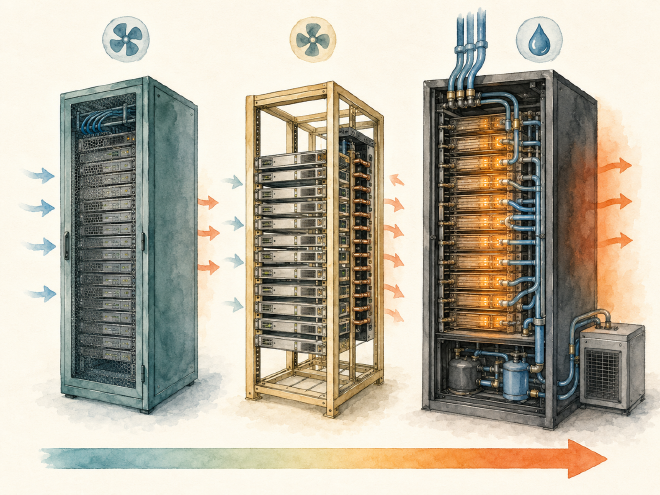
The most visible piece of physical infrastructure inside a data center is the cabinet — the vertical enclosure that houses servers, storage, and network equipment. There has been one dominant standard for thirty years, one challenger for the past decade, and one new paradigm that the AI buildout has forced into existence over the past two years.
數據中心裡最可見的實體基礎設施是機櫃 —— 容納伺服器、儲存、網路設備的垂直機殼。三十年來有一個主導標準,過去十年有一個挑戰者,過去兩年 AI 擴建強迫一個新範式存在。
The 19-inch rack is the universal baseline. Any standard server, switch, or storage unit fits. The supply chain is mature, prices have been commoditized for decades, and any technician can work on one.
OCP Open Rack v2 / v3 — the hyperscaler standard // OCP Open Rack v2 / v3 —— 超大規模標準 #
Around 2011, Facebook (now Meta) founded the Open Compute Project (OCP) to design servers and racks specifically for hyperscaler workloads, where standard 19-inch racks were no longer optimal.
約 2011 年,Facebook(現 Meta)創立 Open Compute Project(OCP,開放運算計畫),專門為超大規模工作負載設計伺服器與機架,標準 19 吋機架在那裡不再最優。
Specification
OCP Open Rack v2/v3
Internal width // 內寬
21 inches (wider — more board space, better cooling)
Depth // 深度
1,067 mm
Height unit // 高度單位
1 OU = 48 mm (larger than 1U for better cooling)
Standard height // 標準高度
42 OU
Typical max load // 典型最大載重
1,400+ kg
Power delivery // 配電
Centralized 48V DC via bus bar (eliminates per-server PSUs) 透過母線集中 48V DC(消除每台伺服器電源)
Cooling // 冷卻
Rack-level designed (not per-server)
Redundancy // 冗餘
No per-server redundant PSU (software-layer fault tolerance)
The key design philosophy is simplification at the server level by centralizing at the rack level. Removing per-server power supplies, per-server fans, and per-server redundancy saves cost and improves efficiency at the scale where the rack is the unit of operation, not the server.
Adopters: Meta (founding), Microsoft, Google (with variants), Alibaba, Tencent. Adoption stayed niche for years because the 19-inch ecosystem was so deep, but the AI workload has accelerated OCP adoption substantially since 2023.
採用者:Meta(創立)、Microsoft、Google(有變體)、阿里、騰訊。採用多年保持利基,因為 19 吋生態系太深,但 AI 工作負載從 2023 年起大幅加速 OCP 採用。
NVIDIA NVL72 — the AI paradigm // NVIDIA NVL72 —— AI 範式 #
In 2024, NVIDIA introduced the GB200 NVL72 — not just a server but an integrated rack-scale system containing 72 Blackwell GPUs plus their associated CPUs, networking, and liquid cooling, all coordinated through high-bandwidth NVLink interconnect within the rack itself.
The NVL72 broke the cabinet design conversation in three ways at once: it forced liquid cooling into the mainstream, it required structural floor reinforcement in most existing facilities, and it embedded the network fabric inside the rack rather than between racks.
The 30-year reign of the 19-inch rack as the universal data center building block is ending. Three standards will coexist for the next decade: 19-inch for traditional enterprise workloads, OCP for hyperscaler cloud workloads, and NVL72-style rack-scale systems for AI training clusters.
19 吋機架作為通用數據中心建構塊統治 30 年的時代正在結束。未來十年三個標準會共存:19 吋給傳統企業工作負載、OCP 給超大規模雲端工作負載、NVL72 風格的機架級系統給 AI 訓練集群。
Part 4 — Structured Cabling and the 400G/800G Optical Surge // 第四部分:結構化佈線與 400G/800G 光模組暴增 #
Cabling is the connective tissue of a data center. It is also one of the most punishing systems to design wrong — once installed, replacing cabling is among the most expensive and disruptive changes a facility can undergo.
Power cabling:
- Heavy copper feeders from switchgear to PDU/rPDU
- Mid-size cabling from PDU to cabinets

Data cabling:
- Fiber between servers and switches, between switches, and to external networks
- Copper (Cat6A / Cat7) for short-distance and edge connections
- Structured cable trays organizing both, kept physically separated
The dominant standard is TIA-942-B, which prescribes both the cable types and the physical separation requirements between power and data cabling to prevent electromagnetic interference.
In modern data centers, fiber has displaced copper for nearly all backbone connections. Copper survives in short intra-cabinet runs and for low-bandwidth edge connections.
AI training clusters need extraordinary east-west bandwidth between GPU servers. A single NVIDIA DGX or NVL72 rack can saturate hundreds of 400G fiber links to its neighbors. This has driven the optical transceiver market into a multi-year capacity-constrained surge.
Lead times for 400G and 800G modules have stretched to 6–12 months with capacity favoring hyperscaler customers. This has become one of the dozen or so supply-chain bottlenecks shaping AI cluster build timelines, alongside HBM memory and high-voltage transformers.
The unglamorous side of cabling: the cable trays, conduits, and labeling that organize tens of thousands of cables across a facility.
佈線不華麗的一面:組織機房裡數萬條纜線的線槽、管道、與標籤。
A handful of design principles that consistently separate good installations from problematic ones:
幾個一致地把好的安裝跟有問題的安裝分開的設計原則:
Power and data trays run separately, ideally with at least 300 mm physical separation, to minimize EMI coupling.
電力與資料線槽分開走,理想上至少 300 mm 物理分隔,以最小化 EMI 耦合。
Overhead and underfloor runs as parallel systems, so one can be maintained while the other carries the active load.
頂部與地板下走線作為平行系統,這樣一個可以保養時另一個承載作用負載。
Strict labeling, with labels at both ends and every 5 meters in between.
嚴格標籤,兩端與中間每 5 公尺都有標籤。
30% spare capacity reserved for future expansion. Adding capacity to a fully filled tray is dramatically more expensive than designing the headroom in originally.
1990s — Mechanical keys
2000s — Magnetic stripe / IC card / RFID
2010s — Fingerprint / iris recognition
2020s — Facial recognition with liveness detection
Future — Multi-modal + AI behavior analytics
Modern high-security data centers run a combination — typically a card or PIN as the first factor, biometric (fingerprint or facial recognition) as the second, with the most sensitive areas (Tier IV cores, financial data halls) adding a third factor or requiring two-person rule entry.
現代高安全數據中心跑組合 —— 典型上卡或 PIN 作第一因子、生物識別(指紋或人臉辨識)作第二因子,最敏感區域(Tier IV 核心、金融資料機房)加第三因子或要求雙人原則進入。
Facial recognition: speed and accuracy expectations // 人臉辨識:速度與準確度期待 #
For data center deployments, the modern expectation is:
對數據中心部署,現代期待是:
Recognition time < 1 second
辨識時間 < 1 秒
Recognition distance up to ~3 meters
辨識距離可達約 3 公尺
Accuracy > 99.6%
準確度 > 99.6%
Liveness detection required (cannot be fooled by a photo or video)
活體偵測必須(不能被照片或影片騙過)
Audit trail — historical facial-recognition photos retained for traceability
稽核軌跡 —— 歷史人臉辨識照片保留供追溯
Mantraps — the anti-tailgating defense // Mantrap —— 反尾隨防禦 #
A mantrap is a small vestibule between two doors that interlock — when one door is open, the other cannot be. Standard mantrap behavior allows only one person at a time to enter, often combined with a floor weight sensor to confirm a single occupant.
The purpose is to defeat tailgating — the social engineering technique where an unauthorized person follows an authorized one through a single-door entry. Tailgating is the single most common physical breach vector for data centers, and a mantrap is the only physical control that reliably defeats it.
High-security facilities (financial, government core) typically require mantraps at every transition between zones. Lower-tier facilities often skip them at perimeter doors and rely on social vigilance — a known weak spot.
Part 6 — Hikvision, Dahua, and the Geopolitical Layer // 第六部分:Hikvision、Dahua 與地緣政治層 #
The IP camera and Video Management System (VMS) supply chain has, since 2019, become one of the clearest examples of how geopolitical decisions reshape data center procurement.
IP 攝影機與 Video Management System(VMS)供應鏈從 2019 年起,變成「地緣政治決策重塑數據中心採購」最清楚的例子之一。
Hikvision and Dahua, prior to 2019, had become two of the largest IP camera manufacturers globally — by some estimates accounting for roughly 40% of all IP cameras sold worldwide. Their products were specified into countless data centers, government buildings, schools, retail chains, and airports.
Hikvision 與 Dahua 在 2019 年前已經變成全球最大的 IP 攝影機製造商兩家 —— 某些估計佔全球賣出的所有 IP 攝影機約 40%。它們的產品被指定進無數的數據中心、政府建物、學校、零售連鎖、機場。
The 2019 National Defense Authorization Act, Section 889, prohibited US federal agencies from procuring or using equipment manufactured by Hikvision, Dahua, Huawei, ZTE, and Hytera. The prohibition extended to federal contractors after a transition period.
The European Union has since taken a similar but less unified stance — public-sector use of Chinese-origin surveillance equipment is restricted or banned in the UK, the Netherlands, Belgium, and parts of Germany, with EU-wide policy still evolving.
Federal contractor data centers — Same restriction extends through the supply chain.
聯邦承包商數據中心 —— 同樣限制延伸到供應鏈。
EU public-sector and critical-infrastructure — Increasingly restricted; check local jurisdiction.
歐盟公部門與關鍵基礎設施 —— 越來越受限;查當地司法管轄區。
Taiwan financial and government — Self-imposed restrictions broadly mirror US position, though not codified into single legislation.
台灣金融與政府 —— 自我設限大致對齊美國立場,雖未編入單一立法。
Australian government facilities — Removed Chinese-origin surveillance equipment from government sites following 2023 audit.
澳洲政府設施 —— 2023 年稽核後從政府場址移除中國製監控設備。
Commercial colocation in most markets — Choice remains open, but increasingly customers (especially multinationals) require disclosure of camera vendor.
The camera vendor decision is now a geopolitical decision. Procurement teams that did not have to think about it before 2019 now have to think about it explicitly — and the consequences of getting it wrong can include disqualification from US federal contracts for the entire colocation provider.
Part 7 — Lightning Protection and Grounding // 第七部分:防雷與接地 #
Uptime Institute incident statistics consistently show that roughly 33% of data center faults trace to electrical-side causes, including grounding inadequacy and lightning damage. This is a high number relative to how little procurement attention these subsystems receive — lightning protection and grounding together typically account for less than 1% of CAPEX but a meaningful share of unplanned failures.
Uptime Institute 事件統計持續顯示約 33% 的數據中心故障可追溯到電氣側原因,包括接地不足與雷擊損壞。相對於這些子系統收到的少量採購注意,這是個高數字 —— 防雷與接地合計典型佔 CAPEX 不到 1%,但佔有意義份額的非計畫性故障。
The IEC 62305 lightning protection zone model // IEC 62305 雷擊防護分區模型 #
The international framework for lightning protection is IEC 62305, which divides a facility’s lightning exposure into four Lightning Protection Zones (LPZ):
At each zone boundary, a Surge Protective Device (SPD) reduces the remaining surge energy to a level safe for the next zone. The class of SPD required depends on the zone boundary it crosses.
在每個區域邊界,SPD(Surge Protective Device,突波保護器) 把剩餘突波能量降到下一個區域安全的等級。所需 SPD 的等級取決於它跨越的區域邊界。
The three classes are used in series, not as alternatives. Class I at the building entry, Class II at the distribution board, Class III at the equipment. Each stage reduces the energy further; relying on any single stage produces inadequate protection.
三個等級串聯使用,不是替代。Class I 在建物入口、Class II 在配電盤、Class III 在設備。每階段進一步降低能量;依賴單一階段產生不足的保護。
A data center requires four conceptually distinct grounding systems that, in modern practice, are bonded together rather than kept separate:
數據中心需要四個概念上不同的接地系統,現代實務上把它們綁定在一起而不是分開保持:
System
Purpose // 目的
Resistance target // 電阻目標
Protective Earth (PE)
Electrical shock protection 電擊保護
< 4 Ω
Functional / working earth
System reference (e.g., neutral point) 系統參考(如中性點)
< 4 Ω
DC earth
Communications equipment ground 通訊設備接地
< 1 Ω
Lightning earth
Lightning current discharge 雷擊電流洩放
< 10 Ω
The integrating principle is equipotential bonding — connecting all of these systems together at a single bonding point. The reasoning is direct: if any two grounding systems are at different electrical potentials, currents will flow between them along whatever paths happen to be available, including signal cables and computer chassis. The damage from these “ground loop” currents can be subtle and pervasive: corrupted data, false alarms, gradually degraded equipment, eventual outright failures.
The authoritative reference for data center grounding design is IEEE 1100 (the “Emerald Book”) — required reading for any serious electrical engineer working in the industry.
The mistakes that cause real-world incidents are not exotic — they are simple, predictable, and persistent across the industry:
造成現實事件的錯誤不是奇特的 —— 是簡單、可預測、整個產業持續存在的:
Grounding grid undersized — Resistance too high; lightning currents elevate building potential and damage equipment.
接地網規模不足 —— 電阻太高;雷擊電流抬升建物電位、損壞設備。
Multiple grounding systems not bonded — Potential differences create destructive ground loops.
多套接地系統未聯結 —— 電位差製造破壞性的接地迴路。
SPDs not staged in series — Single-stage protection lets surge energy through to end equipment.
SPD 未串聯分階段 —— 單階段保護讓突波能量穿透到末端設備。
Cabinet grounding inconsistent — Some cabinets bonded to the grounding bus, others left floating; static buildup and lightning damage.
機櫃接地不一致 —— 部分機櫃聯結到接地母線、其他懸浮;靜電累積與雷擊損害。
Lightning down-conductors broken — A cable that has degraded over time leaves the lightning rod with no path to ground; the lightning finds another path, often through electrical service lines.
避雷引下線斷裂 —— 隨時間衰退的電纜讓避雷針沒有對地路徑;雷擊找另一條路,常常透過電力服務線。
Grounding is the cheapest insurance in the data center, and the most commonly underspecified. It accounts for less than 1% of capital cost but a meaningful fraction of unplanned failures. The cheap-but-critical pattern is consistent across every audit Uptime publishes.
1. 3M is exiting Novec 1230 production by end of 2025 // 3M 在 2025 年底前退出 Novec 1230 生產 #
The dominant clean-agent fire suppression chemical for two decades is leaving the market. Existing facilities are signing long-term supply contracts; new builds are evaluating non-3M FK-5-1-12, Inergen, and aerosol alternatives. A single chemical company decision is reshaping the global data center fire suppression supply chain.
2. VESDA aspirating detection is 700× more sensitive than point detectors // VESDA 抽氣式偵測比點型偵測器敏感 700 倍 #
The industry gold standard for early-warning fire detection. Provides 5 to 30 minutes of warning before a point detector would register — long enough for graceful workload migration or controlled shutdown.
3. Three cabinet standards will coexist for the next decade // 未來十年三個機櫃標準會共存 #
19-inch EIA-310-D for traditional workloads, OCP Open Rack 21-inch for hyperscaler cloud, NVL72-style rack-scale for AI training. Liquid cooling moves from optional to mandatory at the top of this hierarchy.
19 吋 EIA-310-D 給傳統工作負載、OCP Open Rack 21 吋給超大規模雲端、NVL72 風格機架級給 AI 訓練。液冷在這個層級的頂端從選配變成強制。
4. Fiber has displaced copper for backbone connections // 光纖已取代銅纜在骨幹連接 #
Copper survives in short intra-cabinet runs and edge connections. 400G and 800G optical transceivers are now in supply-chain bottleneck status, with 6–12 month lead times allocated by hyperscaler priority.
5. Mantraps are the only reliable defeat for tailgating // Mantrap 是擊敗尾隨唯一可靠的方式 #
Tailgating is the single most common physical breach vector. Mantraps are required in high-security facilities and recommended everywhere — the social engineering vulnerability of single-door entries cannot be reliably trained away.
6. The Hikvision/Dahua restrictions have made camera vendor a geopolitical decision // Hikvision/Dahua 限制把攝影機廠商變成地緣政治決策 #
US 2019 NDAA Section 889 banned federal procurement. EU and allied jurisdictions have followed in various ways. Procurement teams now have to consider end-customer compliance requirements when specifying cameras — a decision that did not exist for most operators before 2019.
7. SPD must be staged in three classes // SPD 必須分三級串聯 #
Class I at building entry, Class II at distribution, Class III at equipment. Used in series, not as alternatives. Single-stage protection lets surge energy through to end equipment.
Class I 在建物入口、Class II 在配電、Class III 在設備。串聯使用、不是替代。單階段保護讓突波能量穿透到末端設備。
8. Equipotential bonding is the single most important grounding principle // 等電位聯結是接地最重要的單一原則 #
All grounding systems — protective earth, working earth, DC earth, lightning earth — bonded together at a single point. The alternative (separate systems at different potentials) creates ground loops that damage equipment subtly and pervasively.
9. The small subsystems sit on the boundary of engineering and policy // 小子系統坐在工程與政策的邊界 #
Fire suppression chemistry is regulated. Surveillance equipment is geopolitically constrained. Lightning protection is governed by international standards. The technical decisions for these subsystems increasingly require legal, regulatory, and geopolitical input alongside the engineering analysis.
The eleventh article in this series turns from the systems inside a data center to the process of building one — the 27-month industry-standard construction timeline, the 9 site-selection principles plus a 10th that practitioners always add, the 3 contracting models (EPC, Design+GC, Design+Devices+PM), the long-lead items that now drive scheduling, and the 5-step Commissioning sequence (FAT → SAT → PFT → FPT → IST) that ends with the dramatic “Pulling the Plug” test. The article will also introduce a working site-selection scoring framework — 10 weighted criteria covering power, climate, water, network, land, design adaptability, disaster resilience, policy, talent, and community impact — that operators and partners can use as a starting template for evaluating any new site.