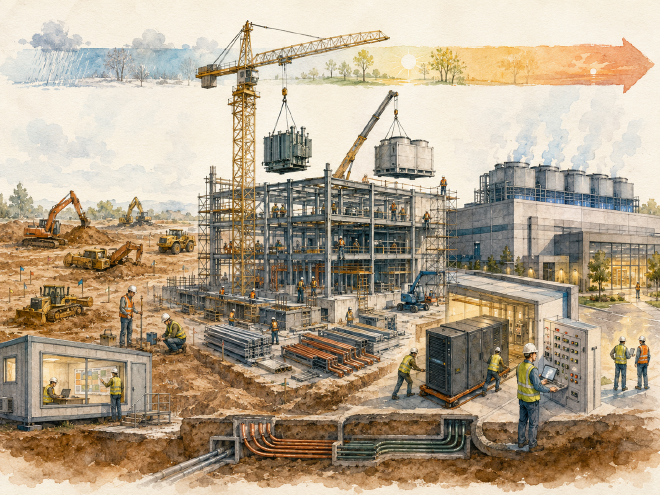
A typical data center takes 957 days to build, end-to-end, from breaking ground to first IT load. The AI infrastructure cycle has compressed equipment refresh times to 18 months. Construction time is now longer than the useful life of the hardware the building was originally specified to hold. The arithmetic does not work — and the industry’s response has reshaped every phase of how data centers get built, from site selection to commissioning to handover.
一座典型數據中心從動土到第一個 IT 負載上線,全程要 957 天。AI 基礎設施週期把設備汰換時間壓縮到 18 個月。建設時間現在比建物原本規劃要承載的硬體有用壽命還長。算術不通 —— 而業界的回應重塑了數據中心如何被蓋的每一個階段,從選址到調試到交接。
Why Construction Is Now the Bottleneck // 為什麼建設現在是瓶頸 #
For most of the data center industry’s history, the bottleneck was equipment. Servers were expensive, hard to procure, and the dominant constraint on what an operator could build. That balance flipped sometime around 2020.
Today the binding constraints sit upstream of the building: grid capacity that takes 3 to 7 years to expand, high-voltage transformers with 5-year lead times, civil construction that takes 14 months and cannot be meaningfully shortened by writing a bigger cheque. The equipment inside the building — the servers, the GPUs, the cooling units — can mostly be obtained within 12 months once the procurement decision is made. The building itself often cannot.
This article walks through how a data center actually gets built in this environment: the four-phase lifecycle, the three contracting models, the site-selection scoring framework that partners use to evaluate candidate locations, and the five-step Commissioning sequence that ends with the dramatic “Pulling the Plug” test before any IT load goes live.
這篇文章走過數據中心在這個環境下實際怎麼被蓋出來:四階段生命週期、三種合約模式、合作夥伴用來評估候選地點的選址評分框架、以及在任何 IT 負載上線前以戲劇性「Pulling the Plug」測試結束的五步 Commissioning 序列。
Part 1 — The Four-Phase Lifecycle // 第一部分:四階段生命週期 #
Every data center build progresses through four phases. The phases are sequential at the highest level but increasingly run in parallel underneath, especially for prefabricated designs.
每個數據中心建設經過四個階段。階段在最高層級上是順序的,但底下越來越多平行進行,特別是預製化設計。
Phase
Typical duration // 典型時程
Main activities // 主要動作
1. Planning 規劃
~3 months
Site selection, TCO modeling, ROI calculation, Tier-level decision 選址、TCO 建模、ROI 計算、Tier 等級決策
2. Design 設計
~6 months
PUE design, Tier design, power density, CFD simulation, drawing production PUE 設計、Tier 設計、功率密度、CFD 模擬、圖紙產出
The first three phases sum to about 27 months as the ideal industry baseline. Actual builds in mainstream markets routinely run 30–36 months, with extreme cases stretching beyond three years. The most-cited real-world example — a 6,000-cabinet facility in Jiangsu, China — took 957 days, almost 32 months.
Part 2 — Where the 957 Days Go // 第二部分:957 天花到哪去 #
The Jiangsu breakdown is instructive because it shows, in concrete days, which steps actually dominate the timeline.
江蘇的拆解很有啟發性,因為它用具體天數顯示哪些步驟實際主導時程。
Step
Days
% of total
Site survey 場勘
7
0.7%
Civil work design 土建設計
120
12.5%
Design bidding 設計招標
90
9.4%
Civil work construction 土建施工
420
43.9% ⭐
Equipment installation 設備安裝
180
18.8%
Commissioning 調試
90
9.4%
Trial run 試運轉
20
2.1%
Rectification 整改
30
3.1%
Total 合計
957
100%
Two observations stand out:
兩個觀察突出:
Civil construction alone consumes 14 months — nearly half the entire timeline. No equipment can be installed until the building structure, slabs, and MEP rough-ins are ready. This is the single largest target for any time-compression strategy.
Pure design activities (site survey + design + design bidding) total 217 days — over seven months. Much of this is sequential information-gathering and approvals; modern parallel workflows can compress it meaningfully without changing the fundamental engineering work.
The compression opportunity is structural, not in working faster on any single step. The 14-month civil construction is what prefabricated modular data centers (PMDCs) are designed to attack — by manufacturing modules in a factory while site work is still in progress, the sequential dependency between civil and equipment can be broken. A later article in this series covers PMDC in depth.
Part 3 — The Three Contracting Models // 第三部分:三種合約模式 #
The owner of a new data center chooses one of three contracting structures. The choice determines who holds the technical risk, who controls equipment selection, and where the margin sits.
新數據中心的業主選擇三種合約結構之一。選擇決定誰持有技術風險、誰控制設備選擇、利潤落在哪。
Model
Coverage // 涵蓋範圍
Typical owner // 典型業主
EPC General Contracting 總包
Design + procurement + construction in one contract 設計 + 採購 + 施工在一個合約
Governments, SMEs without DC expertise 政府、無 DC 專業的中小企業
Design + GC 設計+總包
Design tendered separately; construction tendered separately 設計獨立招標;建設獨立招標
Mid-to-large enterprises with some technical capacity 有一定技術能力的中大型企業
Design + Devices + PM 設計+設備+項目管理
Owner tenders devices directly and manages integration 業主直接招標設備並管理整合
The owner issues one specification document; one general contractor takes responsibility for design, equipment procurement, and construction. The owner receives a turnkey facility at the end and pays a single fixed-price contract.
The advantages are simplicity, single accountability, and low management overhead for the owner. The disadvantages are higher cost (the EPC firm builds in margin for its risk exposure), reduced control over equipment selection (the EPC chooses what is cheapest for them, not what is optimal for 10-year TCO), and limited flexibility once the contract is signed.
The owner first contracts a design firm or consultant to produce the technical specification. The completed design is then tendered separately to a general contractor for construction. The owner manages the boundary between the two contracts.
This is the most common model for mid-to-large enterprise builds. It produces a design that genuinely serves the owner’s long-term interests (the designer’s incentive is owner satisfaction, not contractor margin), and it allows competitive bidding on construction against a clear specification.
The owner contracts the designer, separately tenders the major equipment categories (UPS, chillers, gensets) directly to manufacturers, and contracts a general contractor only for the construction labor and small-equipment integration. The owner manages all three boundaries.
This model requires substantial in-house technical and project-management capacity, but it produces the lowest TCO at scale. A 10,000-cabinet hyperscale order is large enough to negotiate directly with manufacturers, bypassing the layer of margin that a general contractor would add to the equipment line items.
The pattern: the more capable the owner, the more procurement they pull in-house. Smaller owners gladly trade margin for simplicity. Hyperscalers swap simplicity for the cost savings of direct equipment negotiation.
Part 4 — The Long-Lead-Item Crisis // 第四部分:長交期件危機 #
The supply chain article in this series detailed how lead times across the data center supply chain have stretched since 2020. The compressed version for the construction-management perspective:
本系列的供應鏈文章詳述了數據中心供應鏈交期自 2020 年起如何拉長。從建設管理視角的壓縮版本:
Item
Pre-2020 lead time
2025–2026 lead time
Grid connection (100 MW)
18 months
3–7 years
High-voltage transformer
12 months
3–5 years
Diesel genset (1–2 MW)
4 months
6–12 months
Large UPS (500 kVA+)
3 months
4–9 months
Chiller (large)
4 months
6–12 months
Lithium-ion battery cells
3 months
6–12 months
NVIDIA H100 GPU
n/a
6–18 months
400G/800G optical transceiver
n/a
6–12 months
CDU (liquid cooling)
n/a — niche
6–12 months
The traditional procurement playbook — wait until design is final, then issue purchase orders — has stopped working. The replacement playbook has four elements:
傳統採購手冊 —— 等設計定稿再下訂 —— 已經停止運作。替代手冊有四個要素:
Reserve before design. Slot reservations for transformers, GPU allocations, and grid connections are made years before the final site plan is signed off.
設計前先卡位。 變壓器、GPU 配額、電網接入的位置預留在最終場址規劃簽核前幾年就做。
Multi-source by default. Single-source contracts have largely been replaced by frame agreements with two or three suppliers per critical category.
多源預設。 單一來源合約大致被框架協議取代,每個關鍵類別有兩到三個供應商。
Lock prices long. With copper, steel, and chemicals all volatile, 5-to-10-year price-linked contracts are returning to favor.
長期鎖價。 銅、鋼、化學品都波動的情況下,5 到 10 年的價格連動合約重新流行。
Co-invest upstream. Some hyperscalers are co-investing in supplier capacity expansion in exchange for guaranteed allocation.
上游共同投資。 部分超大規模業者跟供應商共投產能擴張以換取保證配額。
Part 5 — Site Selection: The Nine Principles // 第五部分:選址 —— 九個原則 #
Before any of the contracting and procurement decisions can be made, the site itself has to be chosen. Industry experience has settled on a consistent set of principles for evaluating any candidate location.
Practitioners consistently add one criterion that the formal lists rarely include:
實務工作者持續加上一個正式清單很少包括的準則:
10. Proximity to equipment vendor service depots // 靠近設備商售後服務據點
When a UPS or chiller fails at 2 AM, the service contract typically promises an engineer on site within 4 hours. That promise is only as good as the vendor’s ability to fulfill it. Sites that are remote from major service hubs require either pre-positioned spares, a vendor’s commitment to dedicated stationed engineers (expensive), or acceptance of longer response times.
This consideration is rarely written into the formal nine principles because it is too operationally specific. But it has cancelled real projects.
這個考量很少寫進正式九原則,因為它太運轉特定。但它已經取消了實際的專案。
Part 6 — A Site-Selection Scoring Framework // 第六部分:選址評分框架 #
The nine principles tell evaluators what to look at, but not how to compare two sites that score well on different dimensions. A scoring framework provides the missing layer — weighted criteria, defined sub-items, and an explicit comparison method.
Permit timeline, tax incentives, carbon regulations, data sovereignty rules 許可時程、稅務優惠、碳法規、資料主權規則
8
Design Adaptability 設計適應性
5%
Clear height, floor load capacity, module entry path, supportable power density 淨高、樓板載重、模組進入路徑、可支撐功率密度
9
Talent & Service 人才與服務
5%
Skilled MEP technicians in area, vendor service centers within 4-hour drive, training programs, workforce language 當地熟練 MEP 技師、4 小時車程內廠商服務中心、訓練計畫、勞動力語言
10
Community Impact 社區衝擊
5%
Distance from residential, distance from sensitive uses (schools, hospitals), noise tolerance, visual impact 距離住宅、距離敏感用途(學校、醫院)、噪音容忍度、視覺衝擊
For each criterion, a candidate site receives a score from 0 to 5:
對每個準則,候選場址收到 0 到 5 的分數:
Score
Meaning // 意義
0
Unacceptable — a hard disqualification on this criterion 不可接受 —— 在這個準則上是硬性失格
1
Poor — significant problems, would need major remediation 差 —— 重大問題,需要重大修補
2
Below average — workable but constraining 低於平均 —— 可以運作但有約束
3
Average — meets typical industry expectations 平均 —— 滿足典型業界期待
4
Good — above-average performance on this criterion 好 —— 這個準則上高於平均表現
5
Excellent — best-in-class for this criterion 優秀 —— 這個準則上的最佳
A score of 0 on any single criterion is a disqualification regardless of the weighted total. The framework filters for adequacy on every dimension before it optimizes for excellence.
A perfect site would score 5.00. A site that scores 3.00 across all criteria is acceptable but unremarkable. Anything below 2.5 is generally not worth pursuing.
A worked example — three candidate sites // 範例 —— 三個候選場址 #
The framework is most useful when comparing alternative sites for the same project. Three typical archetypes:
框架在比較同一個專案的替代場址時最有用。三個典型原型:
Site A — Cold, remote, cheap power (e.g., Inner Mongolia, Nordic interior)
場址 A —— 寒冷、偏遠、便宜電力(如內蒙古、北歐內陸)
Site B — Urban edge, well-connected, expensive (e.g., Greater Western Sydney, Frankfurt suburb)
場址 B —— 城市邊緣、連線良好、昂貴(如大西雪梨、法蘭克福郊區)
Site C — Established industrial park, balanced (e.g., a Tier-2 city industrial zone)
場址 C —— 既有工業園區、平衡(如二線城市的工業區)
Criterion
Weight
Site A
Site B
Site C
Power
25%
5
3
4
Climate
15%
5
3
3
Water
10%
3
3
4
Network
10%
2
5
4
Land & Layout
10%
5
3
4
Disaster Resilience
10%
4
4
4
Policy & Permitting
5%
4
3
5
Design Adaptability
5%
5
3
4
Talent & Service
5%
2
5
4
Community Impact
5%
5
2
4
Weighted total
100%
4.20
3.35
3.90
Interpretation:
解讀:
Site A wins on raw weighted total (4.20) — strong on the highest-weighted criteria (power, climate, land)
場址 A 在原始加權總分上贏(4.20)—— 在權重最高的準則上強(電力、氣候、土地)
Site C is a close second (3.90) — balanced, no weaknesses
場址 C 緊隨第二(3.90)—— 平衡、無弱點
Site B trails (3.35) — strong network and talent, but weakness on power (the heaviest-weighted criterion) drags the total down
場址 B 落後(3.35)—— 網路與人才強,但電力(權重最高的準則)弱拖低總分
The framework also reveals a less obvious insight: Site A scores 5 on community impact (it is so remote that no one will object) but only 2 on talent (it is so remote that no one wants to work there). These two scores are mathematically independent but operationally correlated in opposite directions.
框架還揭露一個較不明顯的洞察:場址 A 在社區衝擊上得 5(它太偏遠了沒人會抗議),但人才上只得 2(它太偏遠了沒人想去工作)。這兩個分數在數學上獨立但運轉上以相反方向相關。
The 25% / 15% / 10% × 4 / 5% × 5 weight pattern is a reasonable starting point but not universal. Specific projects should adjust based on their constraints:
AI training cluster — Power weight may rise to 35–40%; talent and community weights may drop
AI 訓練集群 —— 電力權重可能升到 35–40%;人才與社區權重可能降
Financial-services Tier IV — Disaster resilience and policy weights may rise; community may rise (reputational risk)
金融服務 Tier IV —— 災害韌性與政策權重可能升;社區可能升(聲譽風險)
Edge data center — Network weight may rise sharply; land and climate may drop
邊緣數據中心 —— 網路權重可能急升;土地與氣候可能降
Highly sustainability-focused build — Water and green-energy share within Power become disproportionately important; specific weights for these may rise
高度永續導向的建設 —— 水與電力內的綠電占比變得不成比例地重要;這些的特定權重可能升
The framework’s value is not in any specific weight set. It is in forcing the evaluation team to make weights explicit, defensible, and consistent across all candidate sites.
框架的價值不在任何特定權重集。是在強迫評估團隊讓權重明確、可辯護、跨所有候選場址一致。
A scoring framework does not make the decision; it makes the disagreement explicit. Two evaluators using the same framework but different weights will converge on the source of their disagreement — which is far more productive than arguing about candidate sites in the abstract.
Part 7 — Commissioning: Why Five Steps // 第七部分:Commissioning —— 為什麼五步 #
Once the building is constructed and equipment installed, the facility is not ready for IT load. Between physical completion and live operations sits Commissioning — a structured five-step verification process that catches defects, validates performance, and proves the facility behaves correctly under failure conditions.
一旦建物建成、設備安裝完,設施還沒準備好接 IT 負載。物理完成與線上運轉之間,坐著 Commissioning —— 一個結構化五步驗證流程,抓缺陷、驗證性能、證明設施在故障條件下行為正確。
Commissioning matters because Uptime Institute research has consistently shown that roughly 62% of unplanned data center outages are caused by human operational error, and a meaningful share of those errors are operators encountering, in production, a situation they had never seen during commissioning. The commissioning sequence is the structured opportunity to surface those situations in advance.
Commissioning 重要,因為 Uptime Institute 研究持續顯示約 62% 的非計畫性數據中心停機由人為運營錯誤造成,而其中有意義份額的錯誤是運維人員在生產環境遇到他們在 commissioning 期間從未見過的情況。Commissioning 序列是事先浮現那些情況的結構化機會。
FAT (Factory Acceptance Test)
        ↓
SAT (Site Acceptance Test)
        ↓
PFT (Pre-Functional Test)
        ↓
FPT (Functional Performance Test)
        ↓
IST (Integrated Systems Test)
        ↓
   Live operations
Each step has a different location, a different scope, and a different witnessing party. Each step catches a specific class of defect that the previous step could not.
每步有不同的地點、不同的範圍、不同的見證方。每步抓前一步無法抓的特定類別缺陷。
The most expensive defect is the one caught in production. The cheapest is the one caught at FAT, before the equipment has even left the factory. The five-step sequence pushes defect detection as far upstream as possible.
Part 8 — FAT: Factory Acceptance Test // 第八部分:FAT —— 工廠驗收測試 #
The first step happens at the equipment manufacturer’s factory, before the equipment ships. The owner (or its agent) travels to the factory and witnesses the equipment running on test loads, verifying that it meets the contracted specifications.
The owner pays travel and accommodation for inspectors plus the labor cost of the third-party commissioning agent. A FAT trip for a major UPS deployment can cost $30,000 to $80,000.
The math justifies it: a defect caught at FAT is fixed in the factory, where parts and engineering expertise are at hand. The same defect caught at SAT (after the equipment has shipped) requires re-shipping or factory-trained engineers traveling to site. A defect caught at PFT or FPT (after installation) requires partial disassembly. A defect caught at IST (just before live operations) can delay project handover by weeks.
數學支持它:在 FAT 抓到的缺陷在工廠裡修,零件與工程專業就在手邊。同樣缺陷在 SAT 抓到(設備已出貨)需要再運回或工廠訓練的工程師到場。在 PFT 或 FPT 抓到(安裝後)需要部分拆除。在 IST 抓到(剛好在線上運轉前)可以延誤專案交接數週。
The cost ratio is roughly 1× : 10× : 100× : 1000× across the five stages.
成本比例橫跨五個階段大致是 1× : 10× : 100× : 1000×。
Part 9 — SAT, PFT, FPT: The Middle Three Steps // 第九部分:SAT、PFT、FPT —— 中間三步 #
After equipment ships and arrives on site, but before installation begins, the Site Acceptance Test verifies that the equipment arrived without shipping damage, that the serial numbers and configuration match what was specified, and that no parts are missing or substituted.
設備出貨抵達現場後、安裝開始前,Site Acceptance Test 驗證設備到貨無運輸損害、序號與配置符合規格、無零件遺失或替換。
This is the smallest of the five steps but it is the legal handoff point for ownership and insurance liability. After SAT signoff, the owner has accepted the equipment.
這是五步裡最小的,但它是所有權與保險責任的法定交接點。SAT 簽核後,業主已接受設備。
Common SAT findings:
常見 SAT 發現:
Shipping damage from vibration or rough handling // 來自振動或粗暴搬運的運輸損害
Wrong serial number (manufacturer shipped the wrong unit) // 序號錯誤(製造商出錯單元)
After equipment is installed (mounted, bolted, plumbed, wired) but before it is energized, the Pre-Functional Test verifies that the installation itself meets specification. This is a checklist-driven inspection covering:
設備安裝(安裝、上栓、配管、配線)後、通電前,Pre-Functional Test 驗證安裝本身符合規格。這是 checklist 驅動的檢驗,涵蓋:
PFT is the step where the largest number of defects are actually found, because installation involves many trades working in parallel under time pressure. A typical PFT for a mid-size facility produces a “Punch List” of 200 to 800 individual items requiring rectification before the next step can proceed.
FPT — Functional Performance Test // FPT —— 功能性能測試 #
With installation complete and Punch List items resolved, equipment is energized. The Functional Performance Test verifies that each control loop and each system actually does what it is supposed to do — that the chiller cools, the UPS holds load through utility loss, the genset starts and synchronizes, the building management system reads the right values, and so on.
安裝完成且 Punch List 項目解決後,設備通電。Functional Performance Test 驗證每個控制迴路與每個系統實際做它應該做的 —— 冷水機冷、UPS 在市電中斷時維持負載、發電機啟動並同步、建物管理系統讀正確的值、等等。
FPT is the step where the design assumptions get tested against the physical reality. This is also where setpoint tuning happens — adjusting parameters from their conservative design defaults to the values that produce optimal real-world performance.
Part 10 — IST: Pulling the Plug // 第十部分:IST —— Pulling the Plug #
The final step is the most dramatic. The Integrated Systems Test runs the whole facility at simulated full load and then triggers failure scenarios to verify that all subsystems coordinate correctly during real failures.
最後一步最戲劇性。Integrated Systems Test 在模擬滿載下跑整座機房,然後觸發故障情境驗證所有子系統在真實故障期間正確協調。
The signature test, the one that gives the article its title, is the “Pulling the Plug” test:
招牌測試,給文章標題的,是 “Pulling the Plug” 測試:
Scenario setup:
- Dummy load of 50% to 100% of design capacity is energized
- All facility subsystems are running normally
- Monitoring is fully instrumented
- Owner, general contractor, commissioning agent, and key vendor reps are all present

The event:
- An operator presses a "simulate utility failure" button
- The main breaker trips
- The entire facility enters emergency mode

Expected response (within milliseconds to minutes):
- T+0: UPS takes over the IT load (zero interruption required)
- T+30 s: Genset starts automatically
- T+60 s: ATS transfers to genset
- T+90 s: System stabilizes on genset power
- T+10 min: Operator manually transitions back to utility
- T+10 min: Full transition complete with zero IT outage

Pass criteria:
✓ IT dummy load has zero power loss throughout
✓ Cooling does not exceed temperature thresholds
✓ DCIM alarms trigger appropriately
✓ Documentation is complete
Many owners hesitate to perform IST because the test really can cause damage if anything in the chain is mis-configured. The risks are real:
許多業主猶豫做 IST,因為測試真的可以造成損害如果鏈條任何環節配置錯誤。風險真實:
A misconfigured ATS could connect generator output to live utility (catastrophic) // 配置錯誤的 ATS 可能把發電機輸出連到帶電市電(災難性)
An undersized UPS battery could fail to hold load through the genset transition window // 規格不足的 UPS 電池可能在發電機過渡窗口期間無法維持負載
A control linkage bug between subsystems could cascade into a real outage // 子系統間的控制聯動 bug 可能連鎖到真實停機
But the alternative — not performing IST and discovering these problems in production — is far worse. A facility that has not been IST’d has unknown unknowns in its emergency response chain. A facility that has been IST’d has at least the known knowns. The first category of risk dominates the second by a wide margin.
但替代方案 —— 不做 IST,在生產環境發現這些問題 —— 遠遠更糟。沒做過 IST 的機房在其緊急響應鏈裡有「未知的未知」。做過 IST 的機房至少有「已知的已知」。第一類風險以巨大幅度主導第二類。
A facility that has not had its plug pulled by deliberate test will eventually have its plug pulled by reality. The first version is controlled, witnessed, and recoverable. The second version is not.
Linkage logic (HVAC shutdown, door unlock, alarm propagation)
Smoke detection + emergency evacuation 偵煙 + 緊急疏散
Safety procedures
Cyberattack simulation (tabletop) 網路攻擊模擬(紙上推演)
Incident response coordination
A facility that successfully passes a multi-scenario IST has demonstrated, through evidence, that its emergency procedures actually work. That evidence is the difference between marketing a Tier IV claim and being able to prove a Tier IV claim.
成功通過多情境 IST 的機房,已經透過證據證明其緊急程序實際運作。那個證據是「行銷 Tier IV 聲明」跟「能證明 Tier IV 聲明」之間的差別。
Part 11 — The Commissioning Agent // 第十一部分:Commissioning Agent #
A consistent feature of professional data center commissioning is the use of an independent third party — the Commissioning Agent (Cx Agent) — who plans, witnesses, and certifies the commissioning sequence on behalf of the owner.
Without an independent Cx Agent, the general contractor is in the position of both performing the construction and validating that the construction is correct. The conflict of interest is structural. Even good-faith contractors are subject to deadline pressure that biases their interpretation of marginal test results.
Cx Agent fees typically run 1% to 3% of total CAPEX. For a $500 million data center build, that is $5 million to $15 million spent on commissioning oversight.
Industry studies have consistently shown that proper commissioning reduces operational failures over the first three years of operations by 20% to 40%. For a facility where a single major outage can cost $1 million to $5 million, the return on commissioning investment is generally positive within the first year of operation and substantial across the equipment lifecycle.
1. 957 days is the realistic baseline // 957 天是現實基線 #
Idealized 27-month timelines exist on paper. Real builds in mainstream markets run 30 to 36 months. Civil construction alone consumes 14 months. Modern PMDC designs target this by parallelizing factory production with on-site civil work.
2. Three contracting models, picked by owner capability // 三種合約模式,依業主能力選 #
EPC for governments and SMEs (simplicity over cost). Design + GC for mid-to-large enterprises (balanced control). Design + Devices + PM for hyperscalers (lowest TCO, highest in-house demand). The choice is structural and rarely reversed mid-project.
3. Lead times have reshaped procurement // 交期已重塑採購 #
Grid connection: 3–7 years. Transformers: 3–5 years. The traditional “wait for design, then order” playbook is dead. Replaced by reservation-before-design, multi-source by default, long-term price locks, and upstream co-investment.
4. Nine site-selection principles plus a tenth // 九個選址原則加第十個 #
The classical nine cover power, climate, water, hazards, EMI, vibration, and zoning. The unofficial tenth — proximity to vendor service depots — is operationally critical but rarely written into formal lists. Both matter.
5. A scoring framework forces explicit weights // 評分框架強迫明確權重 #
Ten weighted criteria, scored 0–5, with the heaviest weights on power (25%) and climate (15%). The framework does not make the decision; it makes the disagreement explicit. Two evaluators using the same framework with different weights converge on the source of disagreement.
AI training: bump Power weight to 35–40%. Financial Tier IV: bump Disaster and Policy. Edge data center: bump Network. The default 25/15/10×4/5×5 pattern is a starting point, not a universal answer.
AI 訓練:把電力權重提到 35–40%。金融 Tier IV:提高災害與政策。邊緣數據中心:提高網路。預設的 25/15/10×4/5×5 模式是起點,不是通用答案。
7. Commissioning has five distinct steps for a reason // Commissioning 有五個不同步驟有原因 #
FAT (factory) → SAT (site arrival) → PFT (post-install) → FPT (energized) → IST (full integration). Defect cost scales by roughly 10× per step. The discipline is moving defect detection as far upstream as possible.
8. “Pulling the Plug” is genuinely necessary // “Pulling the Plug” 真的必要 #
Owners who skip IST keep the unknown unknowns in their emergency response chain. The risk is real but the alternative is worse. A controlled, witnessed, recoverable failure is far better than the eventual real one.
跳過 IST 的業主在緊急響應鏈裡保留「未知的未知」。風險真實但替代方案更糟。受控、被見證、可恢復的故障遠優於最終的真實故障。
9. An independent Commissioning Agent pays for itself // 獨立 Commissioning Agent 自己付得起 #
Cx Agent fees of 1–3% of CAPEX reduce operational failures in the first three years by 20–40%. For any facility where a major outage costs millions, the math is straightforwardly positive.
The twelfth article in this series turns from how data centers get built to how they are evolving — the prefabricated modular data center (PMDC) movement that is compressing 27-month builds to 6 months, the green and sustainability trends (ESG reporting, CBAM, lithium battery thermal management, water restrictions) reshaping site selection, the path toward autonomous operations (already covered partly in article 8, taken further here), and a comparative analysis of the major equipment vendor ecosystems (Vertiv, Schneider, Huawei) and what their architectural choices reveal about where the industry is heading. The thirteenth and final article will then go deep on a single regional case study — Sydney, Australia — combining all the frameworks from earlier articles into a complete picture of one specific data center market.