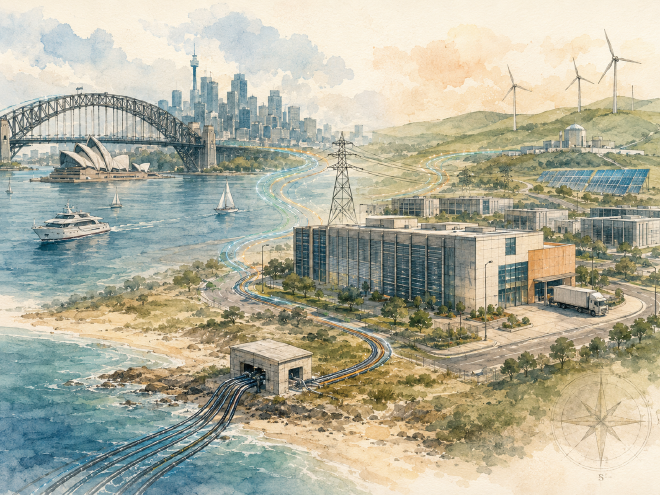
Sydney holds roughly 75% of Australia’s data center capacity, more than four times Melbourne’s share, and serves as the primary digital hub for the entire Asia-Pacific south. In August 2024, Blackstone and Canada Pension Plan Investment Board announced an AUD 24 billion acquisition of AirTrunk — the largest data center transaction in Asia-Pacific history, and the largest single private-equity deal in Australia ever. The buyers were not paying for any one Sydney building. They were paying for what Sydney has become: an infrastructure choke point that hyperscaler AI buildouts cannot route around.
This is the final article in the Data Center 101 series. The previous twelve articles built up the analytical frameworks — the five-layer architecture, the TCO economics, the supply chain map, the reliability and efficiency metrics, the construction and commissioning process, the site-selection scoring framework, the trend forces. This article applies all of them to one specific market, and serves dual audiences: anyone wanting to understand how a real data center market works, and anyone evaluating Sydney as a build location.
這是 Data Center 101 系列的最後一篇文章。前面十二篇建立了分析框架 —— 五層架構、TCO 經濟學、供應鏈地圖、可靠性與能效指標、建設與調試流程、選址評分框架、趨勢力量。這篇文章把所有框架應用到一個特定市場,服務兩個受眾:想理解真實數據中心市場如何運作的任何人,與評估雪梨作為建設地點的任何人。
Three structural advantages give Sydney its dominant position in Australia’s data center market, and a meaningful position in the broader Asia-Pacific south.
三個結構性優勢給雪梨在澳洲數據中心市場的主導地位,與在更廣亞太南部有意義的地位。
Submarine cable concentration. Sydney is the dominant submarine cable landing point for the Australian east coast. Major cables include Southern Cross (NEXT, NEXT2), Hawaiki, Indigo West, Australia-Singapore Cable, and several others. Sydney connects to North America, Asia, and the Pacific Islands with minimum-latency paths that Melbourne, Brisbane, and Perth do not match.
Hyperscaler anchor presence. AWS designated Sydney as its first Australian region in 2012 (ap-southeast-2), Microsoft Azure followed in 2014, Google Cloud in 2017. Each maintains multiple availability zones in the Sydney metropolitan area. Once a region anchor is established, the entire ecosystem of customers, partners, and downstream services concentrates around it.
Financial and government density. The four major Australian banks (Commonwealth, Westpac, NAB, ANZ) are all headquartered in Sydney or run their core IT operations there. The NSW state government and many federal agencies operate substantial IT estates in the Sydney region. The Australian financial sector’s regulatory pressure for in-country data sovereignty makes physical location near customers commercially valuable.
金融與政府密度。 澳洲四大銀行(Commonwealth、Westpac、NAB、ANZ)都在雪梨總部或在那裡運轉核心 IT。NSW 州政府與許多聯邦機構在雪梨區域運轉大量 IT 資產。澳洲金融部門對國內資料主權的法規壓力,讓物理上靠近客戶在商業上有價值。
These three factors compound. The hyperscalers chose Sydney partly because the cables were there, the financial sector clusters because the hyperscalers are there, the colocation operators expand because both are there. The cluster has positive-feedback dynamics.
Part 1 — The Australian DC Market in Context // 第一部分:澳洲 DC 市場脈絡 #
The Australian data center market sits at roughly AUD 6 billion in 2024–2025, growing at a compound annual rate of 12–15%, with the AI buildout currently pushing the upper end of that range.
Three demand sources are running simultaneously in Australia and especially in Sydney:
三個需求來源在澳洲、特別是雪梨,同時運轉:
Hyperscaler region expansion. AWS, Microsoft, and Google have all announced multi-billion-dollar Australian infrastructure investments. Microsoft committed AUD 5 billion in 2024 for cloud and AI infrastructure expansion; AWS announced AUD 13.2 billion by 2027 to expand Sydney and Melbourne regions plus new edge sites.
超大規模業者 region 擴展。 AWS、Microsoft、Google 都已宣布數十億澳幣的澳洲基礎設施投資。Microsoft 2024 年承諾 AUD 50 億 給雲端與 AI 基礎設施擴展;AWS 宣布到 2027 年 AUD 132 億 擴展雪梨與墨爾本 region 加新的邊緣站點。
AI training and inference capacity. Australian financial services, government, healthcare, and education sectors are all building substantial AI capacity, and increasingly demanding sovereign AI options — workloads that run on Australian soil rather than overseas.
AI 訓練與推理容量。 澳洲金融服務、政府、醫療、教育部門都在建構大量 AI 容量,並越來越要求主權 AI 選項 —— 工作負載跑在澳洲土地上而非海外。
Colocation and enterprise migration. Mid-size enterprise customers continue migrating from on-premise to colocation, and from colocation to public cloud, with both ends of the transition increasing Sydney’s net capacity demand.
Building a data center in NSW means navigating four overlapping regulatory layers. Each layer has its own approval pathway, timeline, and disqualifying conditions.
EPBC Act (Environment Protection and Biodiversity Conservation Act 1999)
Federal environmental impact assessment for projects affecting matters of national environmental significance — heritage, water, threatened species 影響國家環境重要事務的專案的聯邦環境影響評估 —— 遺產、水、瀕危物種
SOCI Act (Security of Critical Infrastructure Act 2018, amended 2021)
Data centers classified as critical infrastructure; obligations include cyber-security plans, incident reporting, ownership disclosure 數據中心被分類為關鍵基礎設施;義務包括資安計畫、事件報告、所有權揭露
Privacy Act 1988 + Australian Privacy Principles
Data handling, breach notification, cross-border data flow restrictions 資料處理、洩漏通知、跨境資料流動限制
ACMA (Australian Communications and Media Authority)
Telecommunications carrier licensing if the DC also operates network services 若 DC 同時運轉網路服務則需電信運營商執照
NSW Environmental Planning and Assessment Act 1979
The primary planning approval framework. Most large DCs trigger state-level approval as “State Significant Development” (SSD) 主要規劃核准框架。多數大型 DC 觸發州級核准為「州重要開發」(SSD)
SEPP (State Environmental Planning Policies)
Various SEPPs cover infrastructure, industry, biodiversity, primary production. A DC in an industrial zone typically falls under SEPP (Industry and Employment) 各種 SEPP 涵蓋基礎設施、工業、生物多樣性、主要生產。工業區的 DC 典型上落在 SEPP(工業與就業)下
NSW EPA (Environment Protection Authority)
Air quality, noise, water pollution, contaminated land — operational permits issued separately from planning approval 空氣品質、噪音、水污染、受污染土地 —— 運轉許可跟規劃核准分開發放
NSW Noise Policy for Industry
Cooling towers, gensets, and outdoor equipment subject to specific noise limits based on time of day and surrounding land use 冷卻塔、發電機、戶外設備受時段與周邊土地使用的特定噪音限制
NSW has 128 local councils, each with their own LEP (Local Environmental Plan) and DCP (Development Control Plan) that govern what can be built where within their boundaries.
For most large data center projects, the development application is determined by the state government as State Significant Development, but local council input remains influential — particularly on traffic management, noise, visual impact, and community consultation.
對多數大型數據中心專案,開發申請由州政府決定為 State Significant Development,但地方議會輸入仍有影響力 —— 特別是交通管理、噪音、視覺衝擊、社區諮詢。
Operated by NSW Department of Planning. Star rating system (1–6) for IT equipment efficiency, infrastructure efficiency, and whole-building efficiency. Government and many enterprise tenants increasingly require 4.5+ stars 由 NSW 規劃部運轉。星等系統(1–6)給 IT 設備效率、基礎設施效率、整棟建物效率。政府與許多企業租戶越來越要求 4.5 星以上
NCC Section J (National Construction Code)
Energy efficiency provisions in the building code. DCs have specific exemptions and provisions that interact with NABERS 建築法規中的能效條款。DC 有特定豁免與條款,跟 NABERS 互動
Climate Active
Federal carbon neutrality certification for organizations. Increasingly required by enterprise tenants for sustainability claims 聯邦組織碳中和認證。企業租戶越來越要求做永續主張
Part 3 — NABERS for Data Centres in Depth // 第三部分:NABERS for Data Centres 深入 #
NABERS deserves its own section because it is uniquely Australian, uniquely binding for the market, and frequently misunderstood by international operators.
NSW government tenancy requirements — Many NSW government tenants require 4.5 stars or higher for their hosting facility. Below that threshold, the facility cannot bid for those tenancies.
Enterprise sustainability commitments — Major Australian enterprises (banks, telcos, retailers) increasingly require NABERS minimum thresholds in their colocation contracts to support their own Scope 3 emissions reporting.
Federal sustainability procurement — Climate Active certification and federal procurement guidelines increasingly reference NABERS ratings.
聯邦永續採購 —— Climate Active 認證與聯邦採購指引越來越參考 NABERS 評等。
Industry credibility — In the Australian market specifically, NABERS has accumulated enough industry credibility that “5-star NABERS” is recognized as a meaningful operational signal in a way that, say, a self-claimed PUE figure is not.
產業可信度 —— 在澳洲市場特別,NABERS 已累積足夠的產業可信度,「5 星 NABERS」被認可為有意義的運轉訊號,方式是自稱的 PUE 數字做不到的。
For an operator entering the Sydney market, achieving NABERS certification at 4.5 stars or higher is effectively a commercial prerequisite, not an optional extra.
Power is the binding constraint on Sydney data center growth, more than land, water, or talent. Understanding the NSW power market is the difference between a smooth build and a project that quietly dies in regulatory queue.
The eastern Australian states (NSW, Victoria, Queensland, South Australia, Tasmania, ACT) operate under a single integrated wholesale electricity market called the NEM, operated by AEMO (Australian Energy Market Operator). Western Australia and the Northern Territory operate separate systems.
東澳州(NSW、維多利亞、昆士蘭、南澳、塔斯馬尼亞、ACT)在單一整合躉售電力市場下運作,稱為 NEM,由 AEMO(Australian Energy Market Operator) 運轉。西澳與北領地運轉分開系統。
NEM is one of the world’s longest synchronous power systems, stretching roughly 5,000 km from Cairns to Adelaide. Long thin grids have known stability challenges, and a meaningful share of AEMO’s operational work is managing those challenges.
NEM 是世界最長的同步電力系統之一,從凱恩斯到阿德雷德伸展約 5,000 公里。長薄電網有已知的穩定性挑戰,AEMO 運轉工作有意義份額是管理那些挑戰。
NSW’s coal transition and the resulting grid stress // NSW 燃煤轉型與隨之而來的電網壓力 #
NSW’s electricity has historically been supplied by a small number of very large coal-fired power stations. Three of them are closing or have closed:
NSW 電力歷史上由少數非常大的燃煤電廠供應。其中三座正在關閉或已關閉:
Liddell (1,680 MW) — Closed 2023 // 2023 年關閉
Eraring (2,880 MW) — Originally scheduled to close 2025, extended to 2027 due to grid reliability concerns // 原本預定 2025 年關閉,因電網可靠性顧慮延長到 2027
The replacement is meant to be a combination of renewables, storage, and limited new gas generation, coordinated under the NSW Electricity Infrastructure Roadmap (2020) — a state-level commitment to roughly 12 GW of new renewables and 2 GW of storage by 2030, with an estimated AUD 32 billion of private investment.
The implementation mechanism is the Renewable Energy Zone (REZ) program, designating five geographic zones for concentrated renewable energy development with associated transmission upgrades. The five NSW REZs:
實施機制是 Renewable Energy Zone(REZ) 計畫,指定五個地理區域做集中再生能源開發、加上相關輸電升級。NSW 五個 REZ:
The structural challenge for Sydney data centers is that the coal-to-renewables transition is creating temporary grid capacity stress in exactly the period when AI buildout is creating unprecedented demand. The result is that grid connection lead times for new large industrial loads in NSW have stretched from approximately 18–24 months (pre-2020) to 4–7 years (2025–2026).
The three distribution network service providers (DNSPs) serving the Sydney region:
服務雪梨區域的三個配電網路服務供應商(DNSP):
DNSP
Coverage // 涵蓋
Ausgrid
Sydney CBD, eastern suburbs, north shore, central coast
Endeavour Energy
Western Sydney, Blue Mountains, southern highlands
Essential Energy
Rural NSW (relevant for some far-western projects)
Endeavour Energy’s territory — Western Sydney — is where most new hyperscale and AI builds are concentrating, and consequently where the grid connection backlog is most acute.
Endeavour Energy 的領域 —— 西雪梨 —— 是多數新超大規模與 AI 建設集中的地方,因此也是電網接入待辦最尖銳的地方。
The major operators have responded to grid constraints by signing renewable PPAs directly with generators, bypassing the retail market and accelerating their own grid connection priorities through the AEMO connection process.
NEXTDC holds multiple solar and wind PPAs and is targeting 100% renewable by 2030 across its Australian operations
NEXTDC 持有多個太陽能與風力 PPA,瞄準 2030 年澳洲運轉 100% 再生能源
Microsoft Australia announced PPAs for Australian wind and solar projects supporting its Australian data center load
Microsoft Australia 宣布支持其澳洲數據中心負載的澳洲風力與太陽能專案的 PPA
AWS Australia has signed PPAs for multiple gigawatt-scale projects in NSW and beyond
AWS Australia 已簽多個 GW 規模專案的 PPA,在 NSW 與更廣
Part 5 — Sydney’s Six Major Data Center Clusters // 第五部分:雪梨六大數據中心聚落 #
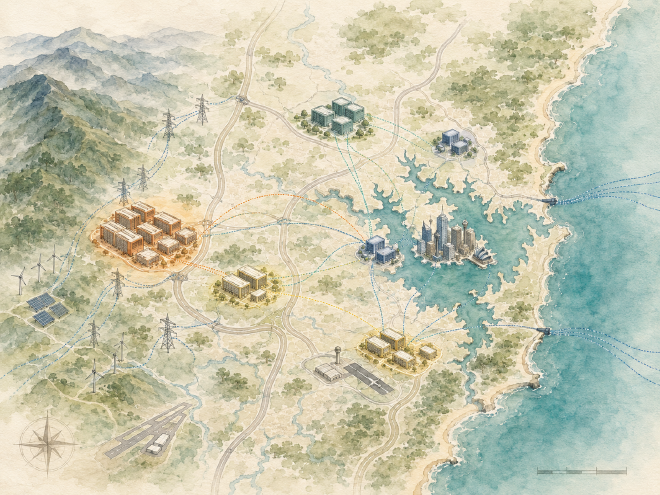
Sydney’s data center capacity is not evenly distributed. It concentrates in six identifiable clusters, each with a distinct profile of cost, latency, customer mix, and operator presence.
A small peninsula on the western edge of Sydney’s CBD. The historical center of Sydney’s data center industry, home to the Equinix and Global Switch facilities that anchor the inner-CBD ecosystem.
雪梨 CBD 西側邊緣的小半島。雪梨數據中心產業的歷史中心,是 Equinix 與 Global Switch 設施的家,錨定內 CBD 生態。
Characteristic
Profile
Primary operators
Equinix (SY4), Global Switch (Sydney West, Sydney East) Equinix(SY4)、Global Switch(Sydney West、Sydney East)
Typical customer
Financial services, internet exchanges, content delivery 金融服務、網際網路交換點、內容傳遞
Land cost
Highest in Sydney 雪梨最高
Power
Ausgrid; very constrained Ausgrid;非常受限
Network
Excellent — peninsula is densely served 優秀 —— 半島密集服務
Inner-west industrial area, including the Olympic Park precinct. Growing presence of mid-tier colocation and edge sites, with reasonable land availability for the location.
內西工業區,包括 Olympic Park 區域。中階 Colocation 與邊緣站點存在成長中,以該位置而言土地可得性合理。
Western Sydney Aerotropolis — the future cluster // 西雪梨航空都會 —— 未來聚落 #
The new Western Sydney International Airport (Nancy-Bird Walton Airport) opens to passenger traffic in late 2026. The NSW government has zoned a substantial area around the airport as the Aerotropolis, with explicit zoning provisions for data centers and other digital infrastructure.
This is the most actively planned new cluster in Australia. Multiple operators have announced intentions, but actual construction is in the planning stage as of 2026. The cluster will likely emerge as a 7th major Sydney cluster over 2027–2030, particularly for operators that can co-locate with the airport’s freight and customs infrastructure.
Founded in 2015, headquartered in Sydney, AirTrunk became the dominant hyperscale-focused operator across Asia-Pacific within a decade. The August 2024 acquisition by Blackstone and Canada Pension Plan Investment Board for AUD 24 billion marked it as the largest data center transaction in Asia-Pacific history.
The global colocation leader, with the deepest Sydney portfolio: SY1 through SY9, spread across Mascot, Pyrmont, Lane Cove West, and Eastern Creek. Operates the Equinix Sydney IX internet exchange.
全球 Colocation 領導者,有最深的雪梨組合:SY1 到 SY9,分布在 Mascot、Pyrmont、Lane Cove West、Eastern Creek。運轉 Equinix Sydney IX 網際網路交換點。
Customer model: retail colocation, network interconnection, with growing hyperscale relationships.
Plus Melbourne (ap-southeast-4); AUD 13.2B committed to 2027
Microsoft Azure
Australia East (Sydney) since 2014; Australia Southeast (Melbourne)
AUD 5B committed in 2024 for AI infrastructure
Google Cloud
Sydney (australia-southeast1) since 2017; Melbourne (australia-southeast2) since 2021
Continued infrastructure expansion
Oracle Cloud
Sydney since 2019; Melbourne since 2021
Government-focused presence
Tencent Cloud
Sydney presence
Limited regional position
Alibaba Cloud
Sydney presence
Limited regional position
The hyperscalers generally do not directly own their Sydney facilities — they lease wholesale capacity from AirTrunk, NEXTDC, and Global Switch, while specifying their own internal designs and operating their own racks within the leased halls.
Part 7 — Applying the Site-Selection Scoring Framework to Sydney // 第七部分:把選址評分框架應用到雪梨 #
Article 11 in this series introduced a 10-criterion weighted scoring framework for site selection. Applied to the six Sydney clusters, the framework illustrates concretely how a buyer’s priorities should map to a cluster choice.
The exercise below uses standard weights (Power 25%, Climate 15%, Water 10%, Network 10%, Land 10%, Disaster 10%, Policy 5%, Adaptability 5%, Talent 5%, Community 5%) and rates each cluster on a 0–5 scale.
Eastern Creek wins on weighted total (3.95) — strong on the heaviest-weighted criterion (Power), excellent on Land/Layout (room for hyperscale builds), and Community (industrial zoning means low resident objection).
Eastern Creek 在加權總分上贏(3.95) —— 在權重最重的準則(電力)上強、土地/佈局優秀(超大規模建設的空間)、社區優秀(工業區意味著低居民反對)。
Mascot and Lane Cove West tie for second (3.45) — strong on Network and Talent, but constrained on Land and Power.
Mascot 與 Lane Cove West 並列第二(3.45) —— 網路與人才強,但土地與電力受限。
Homebush comes third (3.50) — balanced profile, no major weaknesses, no major strengths.
Homebush 第三(3.50) —— 平衡組合、無重大弱點、無重大強項。
Macquarie Park (3.20) and Pyrmont (3.10) trail despite their excellent network and talent scores because the heavy weight on Power penalizes their constrained grid positions.
For an edge / CDN node (Network 30%, Power 10%, Talent 5%) — Mascot wins decisively.
邊緣 / CDN 節點(網路 30%、電力 10%、人才 5%) —— Mascot 決定性地贏。
For a sovereign-government EDC (Disaster 20%, Policy 15%, Community 10%) — Macquarie Park rises sharply (established government cluster); Eastern Creek remains competitive.
主權政府 EDC(災害 20%、政策 15%、社區 10%) —— Macquarie Park 急升(成熟政府聚落);Eastern Creek 仍有競爭力。
The framework’s value, again, is not in producing a definitive answer. It is in forcing the trade-offs to be explicit, defensible, and consistent.
框架的價值,再說一次,不在產生定論答案。是在強迫權衡明確、可辯護、一致。
Part 8 — The Sydney Five-Year Outlook // 第八部分:雪梨五年展望 #
The forces reshaping the global industry — prefabrication, sustainability, autonomy, geopolitical bifurcation — all play out in Sydney with specific local manifestations.
Aggregating the announced expansion plans from hyperscalers, major colocation operators, and the NSW Aerotropolis program, Sydney is on track to roughly double its data center capacity by 2030 — going from approximately 1,200 MW in 2024 to projected 2,400+ MW by 2030. The growth is heavily concentrated in Western Sydney and the new Aerotropolis precinct.
Supply constraints that could throttle growth // 可能扼制成長的供應約束 #
Four specific constraints could slow Sydney’s growth below its demand trajectory:
四個特定約束可能讓雪梨成長放慢到低於其需求軌跡:
Grid connection backlog — Endeavour Energy’s connection queue in Western Sydney is the binding constraint. The NSW Electricity Infrastructure Roadmap is meant to address this, but transmission buildout typically runs 5–10 years behind generation buildout.
Renewable generation buildout timing — The REZ program is on track but multiple projects have faced delays. If renewable generation comes online slower than coal closure, the gap is filled by gas — adding carbon liability that data center operators must then offset elsewhere.
Water restrictions during drought cycles — Sydney has a documented history of multi-year drought (most recently 2017–2020). New facilities specifying evaporative cooling face material risk during drought cycles.
Skilled trades capacity — The combined pressure of Sydney’s ongoing construction boom (Western Sydney Airport, Sydney Metro, residential build-out) plus AI data center construction is straining the skilled electrical, mechanical, and commissioning workforce. Project delays from trades shortages are increasing.
熟練工種容量 —— 雪梨持續建築熱潮(西雪梨機場、雪梨地鐵、住宅建設)加上 AI 數據中心建設的合併壓力,正在拉緊熟練電氣、機械、調試人力。工種短缺造成的專案延誤正在增加。
Investment and policy moves to watch // 值得關注的投資與政策動作 #
NSW Net Zero Plan — State commitment to net zero by 2050, with interim 2030 targets that increasingly affect data center procurement
NSW Net Zero Plan —— 州承諾 2050 年淨零,2030 年中期目標越來越影響數據中心採購
AEMO Integrated System Plan (ISP) — Updated every two years; the current ISP shapes transmission investment decisions through 2050
AEMO Integrated System Plan(ISP) —— 每兩年更新;目前 ISP 塑造到 2050 年的輸電投資決策
Federal Capacity Investment Scheme — Federal underwriting of new dispatchable generation, intended to bridge the coal-to-renewables gap
Western Sydney Aerotropolis Phase 2 planning — Will determine the next decade’s data center cluster boundaries
西雪梨航空都會第二階段規劃 —— 將決定下個十年的數據中心聚落邊界
Part 9 — Practical Decision Framework // 第九部分:實用決策框架 #
For anyone evaluating Sydney as a build location, the analytical journey reduces to a small number of structured decisions, each best made in a specific order.
Grid + corporate PPA — Standard pattern for mid-to-large enterprise builds; requires careful PPA structuring under Australian Renewable Energy Target rules
Anchor-tenant PPA arrangement — For hyperscale, PPAs are typically signed by the tenant rather than the facility operator, with the operator providing the grid connection
錨定租戶 PPA 安排 —— 對超大規模,PPA 典型由租戶簽而不是設施營運者,營運者提供電網接入
Behind-the-meter generation — Increasingly considered for new builds, particularly using solar + storage; faces local council and AEMO interconnection complexity
Any timeline shorter than these for a greenfield build in 2025–2026 should be treated with substantial skepticism. Grid connection alone routinely takes longer than the project sponsors initially assume.
1. Sydney holds roughly 75% of Australian DC capacity for compound reasons // 雪梨持有澳洲約 75% DC 容量,原因複合 #
Submarine cable concentration, hyperscaler anchor presence, and financial sector density all reinforce each other. The cluster has positive-feedback dynamics that are unlikely to reverse.
海底電纜集中、超大規模業者錨定存在、金融部門密度互相強化。聚落有不太可能逆轉的正回饋動態。
2. NABERS is binding, not optional // NABERS 有約束力,不是可選 #
For any operator serious about NSW government or major enterprise tenancies, 4.5 stars or higher is a commercial prerequisite. Plan for it in design, not as an afterthought.
3. The grid connection backlog is the binding constraint // 電網接入待辦是綁定約束 #
Endeavour Energy’s queue in Western Sydney has stretched grid connection lead times to 4–7 years for large industrial loads. This is the single most important variable shaping new-build timelines in Sydney through 2030.
Endeavour Energy 在西雪梨的排隊已把大型工業負載的電網接入交期拉到 4–7 年。這是塑造到 2030 年雪梨新建設時程的最重要單一變數。
Eraring (2,880 MW coal) closing 2027 plus the REZ program’s renewable buildout creates a multi-year gap in baseload generation. Operators that signed PPAs early are protected; latecomers face higher costs and reliability risk.
5. Six clusters serve six different customer profiles // 六個聚落服務六種不同客戶概況 #
Eastern Creek for hyperscale and AI. Macquarie Park for government and enterprise. Mascot and Pyrmont for financial colocation and network. Lane Cove West and Homebush for mid-tier. The clusters are not interchangeable.
Eastern Creek 給超大規模與 AI。Macquarie Park 給政府與企業。Mascot 與 Pyrmont 給金融 Colocation 與網路。Lane Cove West 與 Homebush 給中階。聚落不可互換。
6. The AirTrunk AUD 24B acquisition is a market signal // AirTrunk AUD 240 億收購是市場訊號 #
Blackstone and CPP Investment Board did not pay AUD 24 billion for buildings. They paid for the structural position Sydney occupies in the Asia-Pacific AI infrastructure chain. The acquisition is the clearest statement yet that institutional capital sees Sydney as strategically important rather than incidentally important.
Blackstone 與 CPP 投資委員會不是為建物付 AUD 240 億。他們付的是雪梨在亞太 AI 基礎設施鏈中的結構性位置。這次收購是迄今最清楚的聲明:機構資本看雪梨為戰略上重要,而不是偶然重要。
7. The Western Sydney Aerotropolis will be the seventh major cluster // 西雪梨航空都會將是第七個主要聚落 #
The new airport opens late 2026; the NSW government has zoned data center capacity around it. Most existing operators have signaled intent to build there. The cluster will likely emerge as a major presence over 2027–2030.
8. Realistic build timelines have lengthened // 現實建設時程已拉長 #
A greenfield hyperscale build in Sydney in 2025–2026 should be planned for 4–7 years, not the 2–3 years that was credible pre-2020. Operators that have not adjusted their expectations are systematically missing market windows.
This is the thirteenth and final article in the Data Center 101 series. Over the course of the series, we have built up a complete picture of the data center industry from first principles — beginning with the five-layer architecture in article one, working through the economics, the supply chain, the reliability and efficiency metrics, the four major facility subsystems, the operations discipline of RCA and predictive maintenance, the construction process, the trend forces reshaping the industry, and finally a regional deep-dive into one specific market.
這是 Data Center 101 系列的第十三篇也是最後一篇。整個系列中,我們從第一原理建構了數據中心產業的完整圖像 —— 從第一篇的五層架構開始,走過經濟學、供應鏈、可靠性與能效指標、四大設施子系統、RCA 與預測性維護的運轉學科、建設流程、重塑產業的趨勢力量,最後對一個特定市場做區域深度。
The thread running through every article has been the same: data centers look simple from the outside (a building with servers in it) and are extraordinarily complex from the inside, with technical, economic, regulatory, geopolitical, and operational dimensions that all interact. Understanding any one dimension in isolation produces misleading conclusions. Understanding the interactions is what separates surface knowledge from useful knowledge.
Two structural shifts that ran through the entire series deserve a closing emphasis:
兩個貫穿整個系列的結構性轉變值得最後強調:
The AI buildout has changed everything about the industry’s tempo and scale. Build times, equipment refresh cycles, power density, cooling architecture, supply chain bottlenecks, geographic concentration — all of these have moved in the same direction at the same time, and most of the movement has happened in the past five years. Anyone whose mental model of data centers was formed before 2020 is operating on outdated assumptions.
AI 擴建已經改變了產業節奏與規模的一切。 建設時間、設備汰換週期、功率密度、冷卻架構、供應鏈瓶頸、地理集中 —— 所有這些在同一時間往同一方向移動,多數移動發生在過去五年。任何 2020 年前形成數據中心心智模型的人,正在用過時的假設運作。
The boundaries between technical, regulatory, and geopolitical questions have dissolved. Carbon pricing, water restrictions, vendor restrictions, sovereign-AI requirements, grid connection backlogs — these are not separate concerns to be handed off to separate departments. They are inseparable inputs to every meaningful decision the industry now makes. The successful operator of the late 2020s will be the one whose decision-making fully integrates them rather than treating them as exogenous.
技術、法規、地緣政治問題之間的邊界已經溶解。 碳定價、水限制、廠商限制、主權 AI 要求、電網接入待辦 —— 這些不是要交給不同部門的不同關切。它們是產業現在做每個有意義決策的不可分輸入。2020 年代後期的成功營運者,將是那些決策完全整合它們而不是當外生變數處理的營運者。