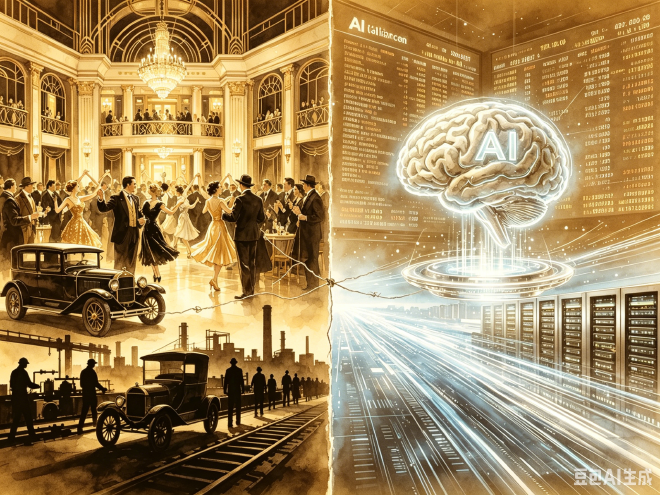
There is an old Chinese saying: “With history as a mirror, one can understand the rise and fall.”
中國有句古話說:「以史為鑑,可以知興替。」
On a recent business trip, I rewatched The Great Gatsby on the flight. Watching the lavish scenes inside Gatsby’s mansion — nights of endless music, champagne pouring like a waterfall — I was hit by a powerful sense of déjà vu.
前陣子出差,在飛機上我重溫了電影《偉大的蓋茲比》(The Great Gatsby)。看著螢幕裡蓋茲比豪宅中夜夜笙歌、香檳如瀑布般流淌的奢華場景,我心裡突然湧起一股強烈的既視感。
The era Fitzgerald immortalized — the so-called “Roaring Twenties” — was precisely the period in American history known as the Coolidge Prosperity. Snapping back to the present, watching Wall Street post record after record on the back of the AI wave, and listening to the tech giants paint their grand visions, I couldn’t help but ask: just how closely does today’s AI boom resemble the Coolidge Prosperity of a century ago? And what dangerous differences lie hidden beneath the surface this time around?
費茲傑羅筆下那個被稱為「咆哮的二十年代」,正是美國歷史上著名的「柯立芝繁榮」時期。而當我回到現實,看著如今華爾街因為 AI 浪潮而屢創新高的股指,以及科技巨頭們描繪的宏大藍圖,我不禁思考:我們現在所經歷的 AI 繁榮,與一百年前的柯立芝繁榮,究竟有多相似?而現在相較過去,又隱藏著哪些危險的差異?
The Underlying Logic of the Boom: Productivity Explosions and Supply-Chain Euphoria // 繁榮的底層邏輯:生產力爆發與供應鏈狂歡 #
The American economic miracle of the 1920s was powered by a single engine: the Ford assembly line. Henry Ford compressed automobile assembly time from over twelve hours to just 93 minutes, and drove the price of the Model T from $850 down to about $260. The result was not only that cars entered millions of ordinary households — it triggered a supply-chain explosion across steel, rubber, glass, petroleum, and the buildout of America’s national highway network.
Fast-forward to today, and AI is this era’s Ford assembly line.
把時間拉回現在,AI 就是這個時代的「福特流水線」。
Since the explosion of generative AI at the end of 2022, the script has played out with uncanny familiarity. Large AI models have dramatically lowered the marginal cost of producing knowledge and content, igniting a new productivity revolution. And that revolution has dragged along a sprawling supply-chain boom of its own: from TSMC’s leading-edge nodes and NVIDIA’s AI accelerators upstream, to server assembly and thermal modules in the middle, all the way down to cloud data centers and the vast power infrastructure they depend on.
從 2022 年底生成式 AI 爆發以來,我們看到了驚人相似的劇本。AI 大模型大幅降低了「知識與內容生產」的邊際成本,引發了新一輪的生產力革命。而這場革命同樣帶動了龐大的供應鏈繁榮:從上游的台積電先進製程、英偉達的 AI 晶片,到中游的伺服器組裝、散熱模組,再到下游的雲端資料中心與龐大的電力基礎設施。
Both eras began with genuine, world-altering technological breakthroughs — and both delivered real, measurable gains in the productivity of the real economy.
兩個時代的起點,都是基於真實且偉大的技術創新,並實實在在地推升了實體經濟的生產力。
The Side Effects of Euphoria: Stock Bubbles and Trade Walls // 狂熱的副作用:股市泡沫與貿易壁壘 #
When productivity explosions meet abundant capital, stock-market bubbles inevitably follow.
當生產力爆發遇上充沛的資金,股市泡沫便應運而生。
In the late 1920s, American investors piled feverishly into the “tech stocks” of the day — companies like the Radio Corporation of America (RCA), whose shares multiplied dozens of times within a few years at price-to-earnings ratios that defied reason. Brokerages even introduced margin trading, letting ordinary citizens put down just 10 percent and borrow the rest to chase the market.
Look at today’s market, and AI-themed stocks are commanding equally extreme valuation premiums. Capital is rushing into a handful of tech giants, pushing the broader indices to one record high after another. AI’s earning power is undeniably real — but the moment sentiment shifts from “investing in the future” to “fear of missing out (FOMO),” the scent of a bubble begins to fill the room.
看看今天的市場,AI 概念股同樣享受著極高的估值溢價。資金瘋狂湧入少數幾家科技巨頭,推動大盤屢創新高。雖然 AI 的獲利能力確實強勁,但當市場情緒從「投資未來」變成「害怕錯過(FOMO)」時,泡沫的氣味就開始蔓延了。
The shadow of protectionism, too, looks strikingly familiar. In an attempt to shield domestic industries, the United States passed the Smoot–Hawley Tariff Act in 1930, triggering a wave of retaliatory tariffs around the world that ultimately gutted international trade. Today, the U.S.–China tech war, chip export controls, and tariff walls are forcibly tearing apart global supply chains. History has shown us, again and again, that when free trade recedes, the resilience of the global economy goes with it.
Where the Mirror Cracks: Risks Unique to Our Era // 鏡像的裂縫:屬於我們這個時代的獨有風險 #
History may rhyme, but today’s macroeconomic environment differs from the 1920s in fundamental ways. And it is precisely in these differences that the risks demanding our greatest vigilance lie:
1. A fiscal position with no historical precedent. As of April 2026, the U.S. national debt has reached roughly $39 trillion. The CBO projects that net interest payments will account for about 14 percent of federal outlays in FY2026 — meaning interest alone now exceeds the entire defense budget. The crash of the late 1920s unfolded against a relatively clean federal balance sheet. Today’s fragile fiscal structure means that the moment a downturn arrives, the government’s room to deploy fiscal stimulus will be severely constrained.
2. The “Thucydides Trap,” now openly on the table. At the May 2026 Beijing summit, the “Thucydides Trap” was explicitly invoked — the structural pressure for conflict between an established power and a rising one, manifesting today as an all-fronts contest across technology, military, and economic domains. Layer on top of that the ongoing war in Ukraine and the smoldering conflicts across the Middle East, and the geopolitical risk we face today runs far higher than anything the 1920s ever knew.
3. The first productivity boom in history where the engine itself is shrinking employment. According to Layoffs.fyi, the U.S. tech sector laid off several hundred thousand workers across 2024 and 2025 combined — and a growing share of CEOs are openly citing AI as the rationale. In the 1920s, Ford’s assembly line created mass employment by turning skilled craftsmanship into work anyone could perform. Today’s analogous technology, at least in the short and medium term, is doing the opposite — substituting for portions of cognitive labor rather than augmenting it. A productivity revolution that simultaneously suppresses middle-class wage income has a fundamentally different demand-side structure from the one Coolidge presided over.
史上第一次「生產力大爆發與就業背道而馳」的繁榮週期。 根據Layoffs.fyi 統計,2024與2025 年 這兩年 美國科技業共有約 數十萬 人被裁。且越來越多 CEO 已開始公開將 AI 列為理由。1920 年代福特裝配線創造了大量就業,因為它把熟練技術工作轉化為任何人都能上手的工作;今天 AI 在短中期內做的事情則相反——它替代部分認知勞動,而不是放大它。當一場生產力革命同時壓低了中產的工資所得,其需求面的結構就和柯立芝當年截然不同。
These three risks compound on one another. A heavily indebted nation with limited fiscal headroom, locked in strategic confrontation with its largest trading partner, riding a productivity wave that is quietly hollowing out middle-class income — this is not the late 1920s. It may, in fact, be more fragile.
The Chain of Cause and Effect: A Warning Bell from the Depression to World War II // 歷史的因果鏈:從大蕭條到二戰的警鐘 #
There is one brutal historical fact we cannot afford to forget: the Coolidge Prosperity ended in the Wall Street crash of 1929, which set off a decade-long Great Depression.
And the Depression was never merely an economic problem. Prolonged unemployment and poverty incubated the extreme nationalism that swept across nations, ultimately lighting the fuse of the Second World War. From boom, to collapse, to global war — this is a clear and painful chain of causation.
I don’t recount this to spread panic. The reason “taking history as a mirror” has endured as wisdom is precisely that mirrors do not predict the future — they show us, in real time, what we look like right now, so that we still have time to change course.
Closing Thoughts: When the Modern-Day Shoeshine Boy Appears // 結語:當現代版的「擦鞋童」出現 #
There is a famous Wall Street story. On the eve of the 1929 crash, Joseph Kennedy Sr. was getting his shoes shined on the street when the shoeshine boy enthusiastically rattled off a few stock tips. Kennedy reportedly walked away with a sudden realization: “When even the shoeshine boy is talking about stocks, the top is in.” He liquidated his positions and dodged the crash that followed. This is the origin of the legendary “shoeshine boy theory.”
Just the other day, a friend of mine who has never paid the slightest attention to the stock market suddenly turned to me over dinner and said: “The U.S. market keeps hitting new highs every single day — the AI stocks especially are going parabolic. I can’t take it anymore. I just opened a U.S. brokerage account yesterday. I’m getting in.”
這幾天,一位從不關心股市的朋友,在吃飯時突然問我說:「我看美股最近天天創新高,特別是那些 AI 股票漲太兇了,實在心癢難耐,昨天剛開了美股帳戶,準備要進場了!」
In that moment, I could almost see the silhouettes from a century ago on the streets of Wall Street.
這時 我彷彿看到了百年前華爾街街頭的那些身影。
With history as our mirror, we may yet understand the rise and fall. Standing before the great era that AI is opening up, we should embrace technological progress while keeping a healthy reverence for the market. After all, when the music is still playing, everyone wants to dance — but the smart ones never stop checking where the exits are.
以史為鑑,可以知興替。在 AI 帶來的偉大時代面前,我們既要擁抱科技的進步,也要保持對市場的敬畏。畢竟,當音樂還在播放時,每個人都想跳舞;但聰明的人,會隨時確認逃生出口的位置。